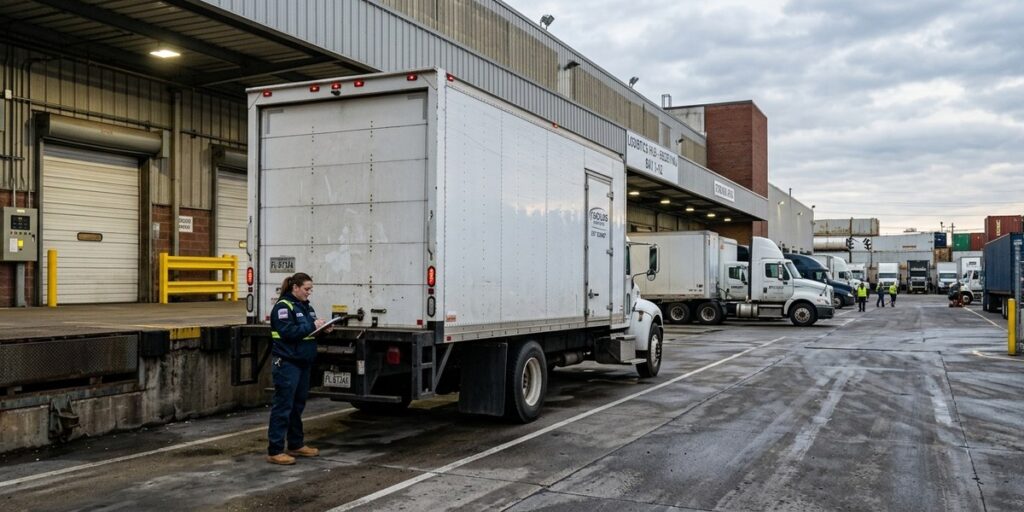
The short answer is that you typically need a Commercial Driver’s License (CDL) to drive a box truck if its Gross Vehicle Weight Rating (GVWR) is 26,001 pounds or more, or if you haul hazardous materials.
Table of Contents
n
- What This Credential Is and Why It Matters
- Eligibility: Who Can Test
- Exam Structure and Content
- General Knowledge (all CDL classes)
- Air Brakes (if applicable)
- Combination Vehicles (Class A)
- Tank Vehicles (endorsement)
- Preparation Roadmap
- Related Careers
- Related questions
n
n
n
n
n
n
n
n
n
n
n
nn
For lighter box trucks under that weight threshold, a standard driver’s license is usually sufficient, though employer policies may vary.
This guide covers the 2026 licensing requirements, exam structure, and costs so you can determine your exact path. All information has been verified against official state DMV and FMCSA sources as of 2026.
What This Credential Is and Why It Matters
The Commercial Driver’s License (CDL) is a federally regulated credential issued by your state’s Department of Motor Vehicles (DMV) or equivalent licensing agency.
It authorizes you to operate large commercial motor vehicles, including box trucks that meet or exceed the 26,001-pound GVWR threshold. The CDL system is designed to ensure drivers meet rigorous safety and competency standards.
Why does this matter for a box truck driver? If you drive a vehicle that requires a CDL without holding one, you face serious penalties, including fines, license suspension, and potential legal liability in an accident.
Moreover, many employers in the logistics and delivery sectors require a CDL even for lighter box trucks to meet insurance requirements or operational flexibility.
Holding a CDL also opens doors to higher-paying jobs and endorsements for specialized cargo like tankers or hazardous materials.
Understanding the answer to “do you need a cdl to drive a box truck” is the first step in your career planning. For example, a 24-foot box truck with a GVWR of 26,000 lbs does not require a CDL, but a 26-foot model with a GVWR of 28,000 lbs does.
Always check the manufacturer’s GVWR sticker on the driver’s side door jamb to be certain.
The distinction between GVWR and actual weight is also critical. GVWR is the maximum safe weight of the vehicle plus its cargo, fuel, passengers, and equipment. Even if your box truck is empty, if its GVWR is 26,001 lbs or more, you need a CDL.
Conversely, a truck with a GVWR of 25,999 lbs never requires a CDL, regardless of how much cargo you load. This is a common point of confusion for new drivers asking “do you need a cdl to drive a box truck” when they plan to carry light loads.
Another factor is the type of cargo. If you haul hazardous materials (hazmat) in any quantity that requires placarding, you need a CDL with a hazmat endorsement, even if the box truck’s GVWR is under 26,001 lbs.
Hazmat includes items like flammable liquids, compressed gases, and certain chemicals. The FMCSA defines these materials in 49 CFR Part 172.
For example, transporting 1,000 gallons of gasoline in a box truck with a GVWR of 20,000 lbs still requires a CDL with a hazmat endorsement because the load itself triggers the requirement.
Employer policies can also override state and federal rules. Some companies, particularly those in the moving and delivery industries, require all box truck drivers to hold a CDL regardless of vehicle weight.
This is often driven by insurance carrier requirements or the need for operational flexibility-if a driver with a standard license is asked to cover a route with a heavier truck, they would be non-compliant.
Always check with your employer’s safety department before assuming a standard license is sufficient.
Eligibility: Who Can Test
To apply for a CDL, you must meet the following eligibility requirements set by the Federal Motor Carrier Safety Administration (FMCSA) and your state DMV:
- Be at least 18 years old for intrastate driving or 21 for interstate driving
- Hold a valid state driver’s license and provide proof of identity and U.S. citizenship or lawful permanent residency
- Pass a U.S. Department of Transportation (DOT) physical examination and obtain a Medical Examiner’s Certificate
- Provide a self-certification of driving type (e.g., non-excepted interstate) and meet state-specific residency requirements
You must also have no disqualifying criminal or driving record violations, such as a DUI within the last five years or a revocation for a serious traffic offense. Some states require a clean driving record for the prior 12 months.
Additional eligibility nuances include vision requirements: you must have at least 20/40 vision in each eye with or without correction, and a 70-degree field of vision in each eye.
Hearing must be sufficient to perceive a forced whisper at 5 feet, or you must pass an audiometric test.
If you have a condition like epilepsy or insulin-dependent diabetes, you may need a special exemption from the FMCSA, which can take 3-6 months to process.
For those wondering “do you need a cdl to drive a box truck” if they have a prior DUI, the answer is that you can still qualify after a waiting period, but you must disclose the offense and may face additional scrutiny during the background check.
The waiting period varies by state but is typically 5-10 years from the date of conviction. Some states, like California, have a 10-year lookback period for DUIs, while others, like Texas, use a 5-year window.
During the application process, you will be required to submit your driving record from all states where you have held a license in the past 10 years.
Residency requirements also vary. Most states require you to be a resident of that state for at least 30 days before applying for a CDL. If you move to a new state, you must transfer your CDL within 30 days of establishing residency.
This is important for drivers who are asking “do you need a cdl to drive a box truck” while relocating for work.
You cannot hold a CDL from multiple states simultaneously, and driving with an out-of-state CDL after establishing residency elsewhere can result in fines and license suspension.
The DOT physical examination is more comprehensive than a standard checkup. It includes a vision test, hearing test, blood pressure check, urinalysis (to screen for diabetes and other conditions), and a review of your medical history.
You must be free from any condition that could impair your ability to drive safely, such as uncontrolled hypertension, sleep apnea, or certain heart conditions.
If you have sleep apnea, you may need to provide documentation of treatment, such as a CPAP machine compliance report, to pass the physical.
The Medical Examiner’s Certificate is valid for up to 24 months, but drivers with certain conditions may receive a certificate valid for only 12 months or less.
Exam Structure and Content
The CDL exam consists of two main parts: a written knowledge test and a three-part skills test.
The written test is typically computer-based with multiple-choice questions, while the skills test is administered in person by a state-certified examiner. You must pass the written test before scheduling the skills test.
Below are the primary content domains you’ll be tested on.
General Knowledge (all CDL classes)
This domain covers vehicle inspection, basic control, cargo handling, accident procedures, and federal safety regulations.
You’ll need to know how to perform a pre-trip inspection, how to handle emergencies, and the rules for hours of service and cargo securement. This is the foundation for all CDL classes.
The general knowledge test typically includes 50-60 questions, and you need a score of 80% or higher to pass.
Common topics include: how to inspect tires for proper inflation and tread depth, how to check brake systems for leaks, and how to secure cargo using tie-downs and dunnage.
You’ll also need to know the maximum driving hours: 11 hours after 10 consecutive hours off, and no driving after 14 hours on duty.
Additional general knowledge topics include understanding the different types of brakes (hydraulic vs. air), how to read a vehicle’s weight rating sticker, and the proper procedures for coupling and uncoupling trailers if applicable.
You’ll also be tested on accident reporting requirements: you must report any accident involving a fatality, injury, or property damage exceeding $500 to the FMCSA within 24 hours.
For box truck drivers, knowing how to properly secure cargo using straps, chains, and dunnage is especially important because improperly secured loads can shift during transit, causing accidents or cargo damage.
The hours of service rules are a frequent source of questions on the general knowledge test. You must understand the 11-hour driving limit, the 14-hour on-duty limit, and the requirement for a 30-minute break after 8 hours of driving.
There are also special rules for adverse driving conditions, which allow you to extend your driving time by up to 2 hours if you encounter unexpected weather or traffic.
However, you must still not exceed 13 hours of driving time or 16 hours of on-duty time in a single day under these conditions.
Air Brakes (if applicable)
If your vehicle is equipped with air brakes, you must pass a separate air brakes knowledge test and demonstrate proficiency during the skills test. This domain covers components, operation, inspection, and troubleshooting of air brake systems.
If you fail the air brakes test, you’ll be restricted from operating vehicles with air brakes.
The air brakes test includes questions about the air compressor, governor, reservoir tanks, brake chambers, slack adjusters, and the emergency braking system.
You must know how to perform a daily air brake check: build pressure to 100-120 psi, turn off the engine, and observe the pressure drop-it should not lose more than 3 psi per minute.
If you’re driving a box truck with air brakes, understanding this is critical because many box trucks in the 26,001+ lb range use air brake systems.
Air brakes are more complex than hydraulic brakes and require specific maintenance knowledge.
You should know how to check the air compressor for oil leaks, how to drain moisture from the air tanks using the drain valves, and how to test the low-pressure warning system.
The low-pressure warning light should activate when pressure drops below 60 psi. If you hear a continuous beep or see a warning light while driving, you must pull over immediately and address the issue.
Driving with low air pressure can cause brake failure, especially on downhill grades.
Another key concept is brake lag. Air brakes take about 0.5 seconds longer to engage than hydraulic brakes because the air must travel through the system. This means you need to allow more following distance when driving a box truck with air brakes.
The FMCSA recommends a following distance of at least 4 seconds for vehicles with air brakes, compared to 3 seconds for vehicles with hydraulic brakes.
This is a common question on the air brakes test and a practical skill you’ll need to demonstrate during the on-road portion of the skills test.
Combination Vehicles (Class A)
This domain applies to Class A CDL applicants and focuses on coupling and uncoupling, trailer handling, and safe operation of tractor-trailers.
You’ll be tested on how to inspect and connect a trailer, how to manage trailer sway, and how to back up with a trailer.
While most box trucks fall under Class B, some larger box trucks with a trailer attachment may require a Class A. If you’re asking “do you need a cdl to drive a box truck” that tows a trailer, the answer depends on the combined GVWR.
For example, a box truck with a GVWR of 24,000 lbs towing a trailer with a GVWR of 8,000 lbs has a combined GVWR of 32,000 lbs, which requires a Class A CDL if the trailer exceeds 10,000 lbs.
The combination vehicles test also covers the proper procedures for coupling and uncoupling a trailer.
You must know how to align the tractor and trailer, connect the air lines and electrical cables, and perform a tug test to ensure the coupling is secure.
The tug test involves pulling forward gently with the trailer brakes applied to verify that the kingpin is locked into the fifth wheel. If you fail to perform this test correctly during the skills test, it can result in an automatic failure.
Managing trailer sway is another critical skill. Trailer sway can occur when the trailer is overloaded, improperly loaded, or when driving at high speeds in crosswinds.
To reduce sway, you should slow down, avoid sudden steering movements, and use the trailer’s brakes if equipped.
Some modern box trucks with trailers have electronic stability control systems that automatically apply brakes to individual wheels to counteract sway.
Understanding how these systems work and when to override them is part of the combination vehicles test.
Tank Vehicles (endorsement)
If you plan to haul liquids in bulk, you’ll need a tank vehicle endorsement. This domain covers liquid surge, loading and unloading procedures, and hazard awareness for bulk liquid transport.
You must pass a separate written test for this endorsement.
The tank endorsement test includes questions about how liquid surge affects vehicle handling during braking and cornering, how to properly vent tanks, and how to inspect for leaks.
For box truck drivers who haul fuel or chemicals, this endorsement is essential and adds about $50-$100 to your total licensing costs.
Liquid surge is the movement of liquid inside a partially filled tank. When you brake, the liquid surges forward, pushing the truck forward and potentially causing a loss of control.
To manage surge, you should avoid sudden braking and cornering, and keep the tank as full as possible to minimize liquid movement. Some tanks have baffles or compartments that reduce surge, but you should still drive cautiously.
The tank endorsement test also covers the proper procedures for loading and unloading hazardous liquids, including grounding the vehicle to prevent static electricity buildup and using the correct hoses and fittings.
If you haul hazardous materials in a tank vehicle, you also need a hazmat endorsement, which requires a separate background check and fingerprinting through the Transportation Security Administration (TSA).
The hazmat endorsement costs an additional $86.50 for the TSA background check, plus any state fees. The background check includes a review of your criminal history, immigration status, and mental health records.
You must renew the hazmat endorsement every 5 years, which requires a new background check each time.
Preparation Roadmap
Follow this step-by-step preparation plan to maximize your chances of passing the CDL exam on your first attempt. Each phase includes a practical insider tip.
- Self-Study (2-4 weeks): Review the state CDL manual and FMCSA regulations; take online practice tests. Focus on understanding the general knowledge and air brakes sections thoroughly before moving to hands-on training.
- Classroom Training (3-6 weeks): Enroll in a certified CDL training program covering vehicle systems, safety, and regulations. Look for programs that include ELDT (Entry-Level Driver Training) certification to meet FMCSA requirements.
- Behind-the-Wheel Practice (2-4 weeks): Hands-on driving practice with a qualified instructor, focusing on pre-trip inspection, maneuvers, and road driving. Log at least 20-30 hours of supervised driving to build confidence.
- Mock Exams & Final Review (1-2 weeks): Simulate written and skills tests; address weak areas and review state-specific requirements. Take at least two full-length mock skills tests with a different instructor to get unbiased feedback.
For those exploring “do you need a cdl to drive a box truck” as a career change, consider that many community colleges offer evening and weekend CDL programs that fit around a full-time job. These programs typically take 8-12 weeks and cost $3,000-$5,000. Some employers, like major delivery companies, offer tuition reimbursement if you commit to
