To get started as an electrician, you can expect a 4- to 5-year timeline combining paid on-the-job training with classroom study, with total out-of-pocket costs estimated between $1,000 and $3,000.
The primary bottleneck is securing a spot in a competitive apprenticeship program. Once licensed, the median annual wage is approximately $60,040 (BLS, 2025 estimate), making this a solid middle-class career path without college debt.
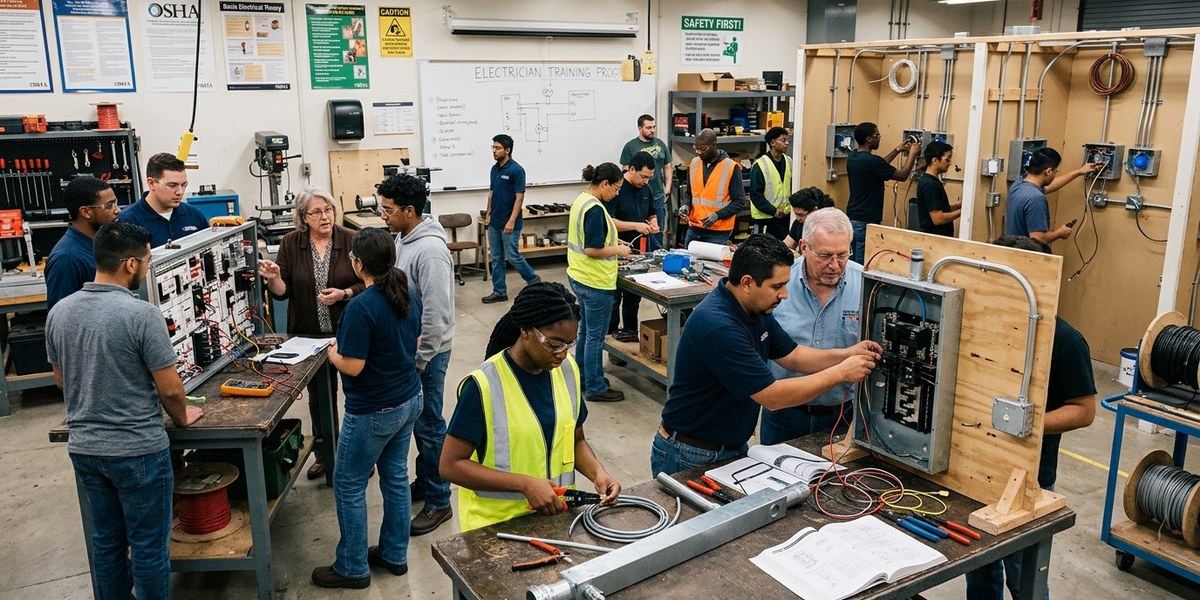
Roadmap at a Glance
| Dimension | Key Details |
|---|---|
| Total timeline | 4–5 years typical (fastest: 4 years; conservative: 6–7 years) |
| Total cost / financing (est.) | $1,000–$3,000 out-of-pocket; apprenticeship is paid, so no student-loan debt |
| Primary hurdle | Passing the aptitude test and securing an apprenticeship slot (union or independent) |
| Compensation snapshot | Median $60,040/yr (2025 BLS estimate); top 10% earn over $100,000 |
Who This Roadmap Is For (and Not For)
This guide is for anyone with a high school diploma or GED who wants a hands-on, well-paying trade career without a four-year college degree. It is designed for career changers, recent graduates, and veterans seeking a structured path to licensure.
If you are already a licensed electrician looking for master-level or contractor licensing, this roadmap covers only the entry-to-journeyman journey.
It is not for those pursuing high-voltage linework or low-voltage data/security installations, which have separate training and licensing requirements.
The Big Picture: Stages From Zero to Job-Ready
Becoming a licensed electrician follows five distinct phases: research and preparation, applying to apprenticeship, completing the 4-year apprenticeship, passing the journeyman licensing exam, and landing your first job.
Each phase has specific milestones and decision points that affect your timeline and costs. The entire process is regulated at the state level, so your exact steps will vary slightly depending on where you live.
Time Investment: Realistic Ranges
The fastest route takes 4 years if you enter an apprenticeship immediately and pass the licensing exam on your first try. A typical timeline is 4.5 to 5 years, accounting for application cycles, exam prep, and job search.
On the conservative end, expect 6 to 7 years if you need to reapply for apprenticeship, attend part-time, or face delays in accumulating required hours. Most apprentices work full-time while attending evening classes, so you earn while you learn.
Cost Reality Check
| Expense Category | Estimated Cost |
|---|---|
| Apprenticeship application fees | $50–$100 for aptitude test and processing |
| Classroom tuition (apprenticeship) | $500–$1,500 total over 4 years (some programs free) |
| Books and tools | $500–$1,000 for NEC code book, hand tools, multimeter |
| Licensing exam fee | $100–$300 per state |
| Background check and drug test | $50–$150 |
| Continuing education (annual) | $100–$300 per year for license renewal |
Most costs are spread across several years, and your apprenticeship wages (typically starting at 40–50% of journeyman pay) offset expenses. Total out-of-pocket spending is far less than a year of community college tuition.
Phase-by-Phase Action Plan
-
Research and Preparation (1–3 months). Confirm you have a high school diploma or GED.
Research local apprenticeship programs through the Joint Apprenticeship and Training Committee (JATC) for union tracks or independent contractor associations for non-union options. Decide whether you want residential, commercial, or industrial focus.
-
Apply to Apprenticeship (1–6 months). Submit your application, sit for the aptitude test, and complete an interview. Programs have annual or biannual intake cycles, so timing matters.
If you are not accepted, consider a pre-apprenticeship program or apply to multiple programs simultaneously.
-
Apprenticeship (Years 1–4). Complete 8,000 hours of on-the-job training plus 576 hours of classroom instruction. You will rotate through different work settings and learn code, safety, and specialized skills.
Annual evaluations determine whether you advance to the next year.
-
Journeyman Licensing (1–3 months). After completing apprenticeship hours and classroom requirements, prepare for the state journeyman electrician exam. Most states use the National Electrical Code (NEC) as the basis. The exam is rigorous;
expect to study 40–80 hours.
-
Job Placement and Early Career (1–6 months). With your license in hand, search for journeyman positions through union dispatch, online boards, or contractor networks.
Invest in a quality tool kit and consider joining professional organizations for ongoing work leads.
Key Terms & 2026 Industry Updates
2026 Industry Note: The National Electrical Code (NEC) 2026 edition is expected to include updated requirements for electric vehicle (EV) charging infrastructure and solar-plus-storage systems.
Apprentices who gain early exposure to these technologies will have a competitive edge in the job market.
Apprenticeship
- A structured training program combining paid on-the-job work (8,000 hours) with related classroom instruction (576 hours). It is the standard pathway to journeyman licensure in most states.
Journeyman Electrician
- A licensed electrician who has completed an apprenticeship and passed the state exam. Journeymen can work independently but cannot pull permits or run a business without a master license.
National Electrical Code (NEC)
- The benchmark standard for safe electrical installation in the United States, updated every three years. The 2026 edition will emphasize renewable energy integration and arc-fault protection.
IBEW (International Brotherhood of Electrical Workers)
- The primary union representing electricians. Union apprenticeships typically offer higher wages and benefits but may have longer waitlists than non-union programs.
Reciprocity
- An agreement between states that allows a licensed electrician from one state to obtain a license in another without retaking the full exam. As of 2026, about 20 states have partial or full reciprocity.
Pre-Apprenticeship
- A short-term program (typically 6–12 weeks) that prepares candidates for apprenticeship entry. It is especially useful for those who need to improve math skills or gain construction safety certifications before applying.

Licensing & State Variations (Compact)
Licensing is managed at the state level, so requirements vary. Most states require completion of an approved apprenticeship (8,000 hours) plus 576 classroom hours, a passing score on the journeyman exam, and a background check.
Some states, like California and Texas, have additional local endorsements for specialties such as fire alarm or solar installation.
As of 2026, the Electrical Licensing Compact is under development, which would allow licensed electricians to work across member states more easily, but it is not yet operational in all states.
Always verify with your state’s licensing board before starting an out-of-state program.
Salary & Job Outlook
Electricians earn a solid middle-class income without a four-year college degree. Based on the latest available BLS figures, the median annual wage for electricians is approximately $60,040, with the top 10% earning over $100,000.
The job market is strong: the BLS projects 7% growth from 2024 to 2034, which is faster than the average for all occupations.
This growth is driven by new construction, renewable energy installations, and the need to upgrade aging electrical infrastructure.
| Metric | Value |
|---|---|
| Median Annual Salary | $60,040 |
| Top 10% Annual Salary | Over $100,000 |
| Entry-Level (Apprentice) Hourly Wage | $15 – $25 per hour (varies by region and year) |
| Job Growth (2024-2034) | 7% (faster than average) |
| Typical Work Hours | Full-time, often with overtime and weekend work |
Salary by Practice Setting
Where you work significantly impacts your starting pay and work-life balance. The table below provides estimates based on industry data.
| Practice Setting | Starting Salary (est.) | Work-Life Balance |
|---|---|---|
| Residential (New Construction) | $40,000 – $50,000 | Good; generally predictable hours with some overtime |
| Commercial (Offices, Retail) | $45,000 – $55,000 | Moderate; may include night or weekend work for tenant improvements |
| Industrial (Factories, Plants) | $50,000 – $65,000 | Challenging; often requires shift work and on-call duty |
| Maintenance (Hospitals, Schools) | $48,000 – $58,000 | Excellent; typically fixed schedules with paid holidays |
| Union (IBEW) | $50,000+ (with full benefits) | Good; strong protections and defined work hours |
- Salaries are higher in states with strong union presence, such as Illinois, New York, and California.
- Industrial electricians often earn premium pay for hazardous environments and specialized skills.
- Overtime is common in all settings, especially during peak construction seasons.
Getting Your First Role
Landing your first job as a licensed journeyman electrician requires a strategic approach. The apprenticeship is the primary gateway, but your first role after licensure sets the tone for your career. Here is how to navigate that transition.
Start your search before you pass the licensing exam. Many contractors hire apprentices who are about to test, contingent on passing.
Use union dispatch systems if you are in an IBEW program, or leverage online job boards like Indeed and ConstructionJobs.com. Your apprenticeship instructors and fellow journeymen are also excellent sources of leads.
Your resume should highlight your apprenticeship hours, specific skills (e.g., conduit bending, motor controls, fire alarm systems), and any safety certifications you have earned. Emphasize your familiarity with the National Electrical Code (NEC).
A clean, professional resume that lists your completed hours and classroom training will stand out.
During interviews, be prepared to discuss a specific project you worked on during your apprenticeship. Describe the task, the code requirements you followed, and the outcome.
Employers want to see that you can apply code knowledge to real-world situations. Also, be ready to answer basic safety questions, such as proper lockout/tagout procedures.
Consider taking a pre-apprenticeship program if you are struggling to get accepted into a standard apprenticeship. These short programs (6–12 weeks) provide basic skills and safety certifications, making you a more competitive candidate.
They also offer direct connections to contractors looking for entry-level workers.
Finally, invest in a quality tool kit. Most contractors expect you to have your own basic hand tools, including screwdrivers, pliers, wire strippers, a multimeter, and a tape measure. A well-organized tool bag signals professionalism and readiness.
Career Progression & Specializations
The electrician career path does not end with a journeyman license. Many electricians advance to master electrician, contractor, or specialized technician roles. Each step brings higher pay, more responsibility, and greater autonomy.
Journeyman to Master Electrician
After working as a licensed journeyman for two to four years (depending on your state), you can apply for the master electrician exam. A master electrician can pull permits, design electrical systems, and supervise other electricians.
This credential is essential if you want to start your own contracting business. The exam is more advanced than the journeyman test and covers load calculations, transformer sizing, and complex NEC applications.
Licensed Electrical Contractor
With a master license, you can apply for an electrical contractor license, which allows you to bid on projects, hire employees, and run a business. This path requires business skills such as estimating, project management, and customer service.
Many electricians find this the most lucrative route, with successful contractors earning well over $150,000 annually.
Specializations
Specializing in a high-demand area can boost your income and job security. Consider these options:
- Industrial Electrician: Focus on factory automation, PLCs (programmable logic controllers), and high-voltage systems. Industrial electricians often
