Becoming a licensed plumber typically requires a 4-to-5-year apprenticeship, followed by a state-administered journeyman exam costing an estimated $50–$200 in fees.
The main bottleneck is completing the required supervised work hours, but once licensed, plumbers earn a median annual wage of over $60,000 according to the latest available BLS figures.
This guide explains exactly how to become a licensed plumber, from eligibility to exam day.
Note: Licensing requirements vary by state. Always verify the latest rules with your state plumbing board or a trusted official source such as the National Association of State Contractors Licensing Agencies (NASCLA).
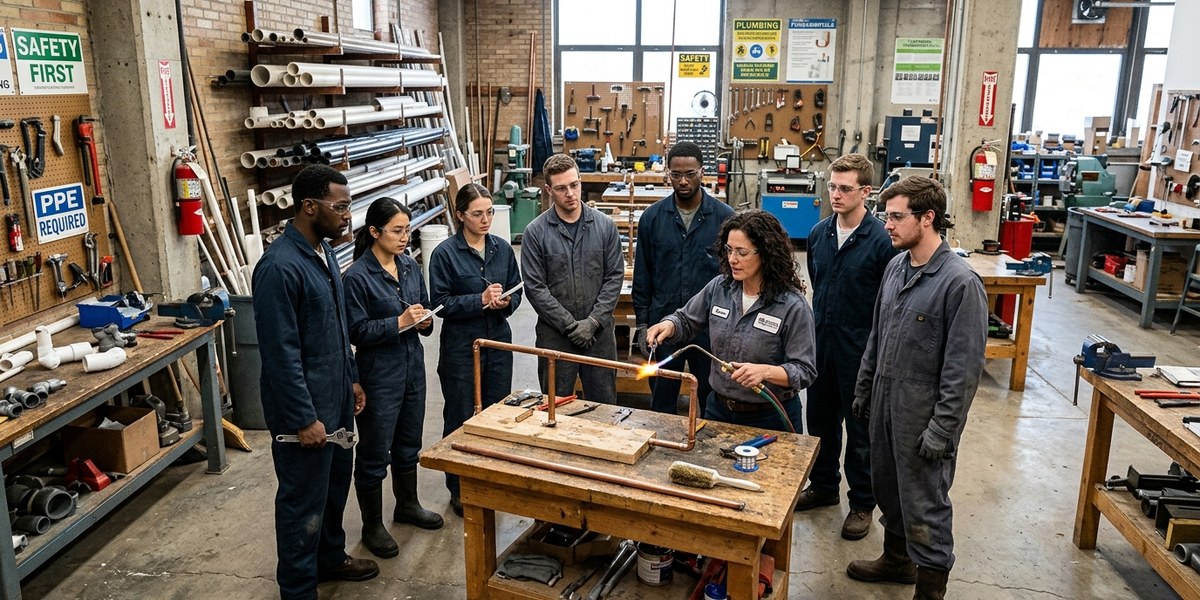
What This Credential Is and Why It Matters
A Journeyman Plumber License is the standard credential that allows you to work independently on plumbing systems in most states.
It proves you have completed a state-approved apprenticeship, passed a rigorous exam, and understand plumbing codes, safety, and trade practices.
Without this license, you can only work under the supervision of a licensed master plumber. Earning it unlocks higher pay, greater job security, and the ability to take on your own projects.
It is a critical step for anyone serious about how to become a licensed plumber and build a stable career in the trades.
Beyond the immediate financial benefits, holding a journeyman license signals to employers and clients that you have met a standardized level of competence.
This credential can open doors to union membership, specialized commercial work, and positions with larger construction firms that require licensed personnel for insurance and bonding purposes.
In many states, only licensed journeymen can legally perform certain tasks like installing gas lines or backflow prevention devices, making the license a non-negotiable requirement for advancing in the field.
Additionally, the license provides portability—many states have reciprocity agreements that allow you to transfer your credential without retaking the entire exam, though additional fees or supplemental tests may apply.
The financial impact of obtaining a license is substantial.
According to the Bureau of Labor Statistics, the median annual wage for plumbers, pipefitters, and steamfitters was $60,090 in May 2023, but licensed journeymen typically earn 20–30% more than unlicensed apprentices.
In high-demand areas like California, New York, and Texas, experienced journeymen can earn $80,000–$100,000 annually, especially if they work in commercial construction or industrial settings.
The license also provides a pathway to becoming a master plumber, which can lead to even higher earnings—master plumbers often earn $90,000–$120,000 per year, and those who start their own businesses can exceed $150,000 annually.
Beyond wages, licensed plumbers often receive better benefits packages, including health insurance, retirement plans, and paid time off, which are less common for unlicensed workers.
Job security is another compelling reason to pursue licensure. The plumbing trade is essential infrastructure work that cannot be outsourced or automated easily.
The BLS projects 2% employment growth for plumbers from 2023 to 2033, which is about average, but licensed plumbers face lower unemployment rates than unlicensed workers.
During economic downturns, licensed plumbers are often in higher demand because building owners must maintain systems and comply with codes, regardless of the broader economy.
Additionally, the aging workforce—many master plumbers are nearing retirement—creates opportunities for new journeymen to fill leadership roles.
By 2026, an estimated 20% of the current plumbing workforce will be eligible for retirement, creating a skills gap that licensed plumbers can exploit for better wages and faster advancement.
Eligibility: Who Can Test
Before you can sit for the journeyman plumber exam, you must meet specific eligibility requirements set by your state plumbing board. These generally include completing an approved apprenticeship and proving your work experience.
- Complete a state-approved apprenticeship program (typically 4–5 years, 8,000 hours of on-the-job training plus related classroom instruction).
- Provide proof of at least 2 years of work experience as a registered apprentice plumber (varies by state; verify with your state board).
- Submit a completed application, fee (estimated $50–$200), and any required supporting documents (e.g., apprenticeship completion certificate).
Some states may also require a background check or proof of residency. Check your state board’s website for the exact documentation needed.
It is important to note that eligibility requirements can differ significantly between states.
For example, California requires 4 years of apprenticeship under a certified training program, while Texas mandates 4,000 hours of on-the-job training plus 240 hours of classroom instruction.
Some states, like New York, have separate licensing pathways for residential versus commercial plumbing.
If you have prior military experience as a plumbing specialist, many states offer credit toward apprenticeship hours through the Military Occupational Specialty (MOS) crosswalk program.
Similarly, graduates of accredited trade school programs may receive partial credit for classroom hours, reducing the total apprenticeship duration.
Always request a preliminary eligibility review from your state board before enrolling in any program to avoid surprises later.
To begin the eligibility process, you must first register as an apprentice with your state board. This typically requires a high school diploma or GED, a clean background check, and enrollment in a state-approved apprenticeship program.
Many apprenticeships are sponsored by local unions, such as the United Association (UA), or by non-union trade associations like the Plumbing-Heating-Cooling Contractors Association (PHCC).
The application process for apprenticeship programs can be competitive—some programs accept only 10–20% of applicants—so it is wise to apply to multiple programs simultaneously.
You may also need to pass an aptitude test in math and reading comprehension before being accepted into an apprenticeship.
Once registered, you will receive a logbook to track your work hours, which must be signed by your supervising journeyman or master plumber and submitted to the state board periodically.
Another critical eligibility factor is the type of work experience you accumulate.
Most states require that your apprenticeship hours include a minimum number of hours in specific categories, such as residential plumbing, commercial plumbing, and service work.
For example, Ohio requires 1,500 hours of residential plumbing, 1,500 hours of commercial plumbing, and 1,000 hours of service and repair work out of the total 8,000 hours.
If your apprenticeship focuses too heavily on one area, you may need to extend your training to meet the diversity requirements.
Keep detailed records of the types of projects you work on, including photographs and supervisor notes, as some states may audit your logbook before approving your exam application.
Additionally, if you change employers during your apprenticeship, ensure that your new employer is also state-approved to train apprentices, or your hours may not count toward the total.
Exam Structure and Content
The journeyman plumber exam is a computer-based test, typically 100–150 multiple-choice questions with a time limit of 3–4 hours. It covers four main domains, each testing your knowledge of plumbing codes, systems, and safety.
Plumbing Codes and Regulations
Focus on the International Plumbing Code (IPC) or Uniform Plumbing Code (UPC) as adopted by your state. Study fixture clearances, vent sizing, and backflow prevention. Know the key tables and definitions that appear most often on the exam.
This domain typically accounts for 25–30% of the exam questions. You should memorize common code sections such as Table 702.1 (minimum trap sizes), Table 703.2 (vent sizing for fixture units), and Section 608 (backflow prevention requirements).
Many test-takers underestimate the importance of understanding code intent—questions often present scenarios where you must apply a code rule to a novel situation rather than simply recall a number.
For example, you might be asked to determine the correct vent size for a bathroom group with specific fixture counts, requiring you to calculate total fixture units and cross-reference the appropriate table.
Practice interpreting code language by reading actual code commentary from the ICC or IAPMO, which explains the reasoning behind each rule.
To master this domain, create a study schedule that dedicates at least 2–3 hours per week to code book reading. Start by reading the table of contents and index to understand how the code is organized. Then, focus on the most frequently tested
chapters: Chapter 3 (General Regulations), Chapter 4 (Fixtures and Faucets), Chapter 7 (Sanitary Drainage), Chapter 8 (Indirect Wastes), Chapter 9 (Vents), Chapter 10 (Traps and Interceptors), and Chapter 11 (Storm Drainage).
For each chapter, create flashcards with key definitions, tables, and code numbers. Use online resources like the ICC’s code interpretation database to see how code rules are applied in real-world scenarios.
Finally, take advantage of code book practice drills—set a timer and try to find specific code sections within 30 seconds.
This skill is critical because the exam is open-book in most states, and efficient navigation can save you 10–15 minutes during the test.
Water Supply and Distribution
Understand pipe materials, sizing, pressure requirements, and cross-connection control. Review water heater installation and safety. Be prepared to calculate flow rates and pressure drops.
Water supply questions often involve calculating the required pipe diameter for a given flow rate and pressure loss over distance. You should be comfortable using the Hazen-Williams formula or simplified tables from the code book.
Common pipe materials tested include copper (Type K, L, M), PEX, CPVC, and galvanized steel, each with different pressure ratings and installation requirements.
Water heater topics cover temperature and pressure relief valves, expansion tanks, and clearance distances from combustibles.
Cross-connection control is a frequent focus—know the difference between air gaps, reduced pressure zone (RPZ) devices, and double-check valve assemblies, as well as where each is required by code.
Expect at least 5–10 questions on backflow prevention alone.
To deepen your understanding of water supply systems, study the principles of water pressure and flow.
Municipal water systems typically deliver water at 40–80 psi, but residential systems often require pressure-reducing valves if the incoming pressure exceeds 80 psi. You should know how to calculate pressure loss due to friction in pipes using the
Hazen-Williams formula: pressure drop = (0.2083 × (100/C)^1.852 × Q^1.852) / d^4.8655, where C is the pipe roughness coefficient, Q is the flow rate in gallons per minute, and d is the pipe diameter in inches.
Practice with sample problems: for example, calculate the pressure drop in 100 feet of 3/4-inch copper pipe carrying 5 GPM of water.
Also, study water hammer arrestors, which are required by code in many states for quick-closing valves like those in washing machines and dishwashers.
Finally, review the installation requirements for tankless water heaters, which are becoming more common and have specific venting and gas supply requirements that differ from traditional tank-style heaters.
Drain, Waste, and Vent (DWV) Systems
Master trap types, venting methods, slope requirements, and waste pipe sizing. Know how to calculate fixture units and design proper drainage systems. This domain often carries the most weight on the exam.
DWV systems typically represent 30–35% of the exam, making it the most heavily weighted domain.
You must understand the difference between wet venting, dry venting, circuit venting, and island venting, as well as the maximum distance from a trap to its vent (trap arm length).
Slope requirements are critical: 1/4 inch per foot for pipes 3 inches and smaller, 1/8 inch per foot for pipes 4 inches and larger.
Fixture unit values are found in Table 709.1 of the IPC, and you must be able to sum fixture units for a given layout and select the correct pipe diameter from Table 710.1.
Common pitfalls include forgetting to add the fixture unit value for a garbage disposal or incorrectly sizing a vent when multiple fixtures share a common vent. Practice with real-world bathroom and kitchen layouts to build confidence.
To master DWV systems, start by memorizing the fixture unit values for common fixtures: a lavatory is 1 FU, a toilet is 3 FU (1.6 GPF) or 4 FU (3.5 GPF), a bathtub is 2 FU, a shower is 2 FU, a kitchen sink is 2 FU, and a washing machine is 2 FU.
Then, practice calculating total fixture units for various room layouts. For example, a full bathroom with a lavatory (1 FU), toilet (3 FU), bathtub (2 FU), and shower (2 FU) totals 8 FU.
Using Table 710.1, a 3-inch pipe can handle up to 20 FU at 1/4 inch per foot slope, so a 3-inch pipe is sufficient for this bathroom group.
However, if the bathroom also includes a bidet (1 FU) and a urinal (2 FU), the total becomes 11 FU, still within the 3-inch pipe capacity.
For vent sizing, use Table 703.2: the vent diameter must be at least half the drain diameter, but never less than 1-1/4 inches.
Practice with complex layouts that include multiple bathrooms, kitchens, and laundry rooms to ensure you can handle any scenario the exam throws at you.
Safety and Tools
Review OSHA safety standards, personal protective equipment, proper use of hand and power tools, and safe handling of hazardous materials. Expect questions on job site safety practices and emergency procedures.
Safety questions are straightforward but easy to miss if you neglect this domain.
Key topics include lockout/tagout procedures for water and gas lines, proper ladder setup (4:1 ratio), trench safety (sloping, shoring, and shielding for depths over 5 feet), and handling of lead, asbestos, and solder fumes.
Tool identification questions may ask about the correct tool for cutting cast iron (snap cutter vs. reciprocating saw) or the proper use of a pipe threader.
Emergency procedures cover what to do in case of a gas leak (evacuate, call utility, do not operate electrical switches) or a major water line break (shut off main valve, call supervisor).
OSHA requires that all plumbers working on construction sites have 10-hour or 30-hour construction safety training—this is often a prerequisite for apprenticeship completion, so review your training materials before the exam.
To prepare for safety questions, review the OSHA 10-hour construction safety curriculum, which covers topics like fall protection, electrical safety, personal protective equipment (PPE), and hazard communication. Pay special attention to the
following areas: proper use of respirators when working with solder fumes or asbestos, safe operation of power tools like reciprocating saws and pipe threaders, and emergency response procedures for confined spaces (e.g., when working in crawl spaces
or septic tanks). Also, study the Material Safety Data Sheets (MSDS) for common plumbing chemicals like PVC cement, primer, and flux. The exam may ask about the proper storage and disposal of these materials.
Finally, practice identifying tools from images—the exam may show a picture of a tool and ask you to select its name or purpose. Common tools include pipe wrenches, basin wrenches, tubing cutters, flaring tools, and propress tools.
Knowing the difference between a closet auger and a toilet auger, for example, could earn you an easy point.
Preparation Roadmap
Follow this structured plan to prepare efficiently for the journeyman plumber exam. Each phase builds on the last, ensuring you cover all content domains and build test-taking confidence.
- Foundation Review (4–6 weeks): Read the applicable plumbing code book (IPC or UPC) cover to cover. Take notes on key tables and definitions. Focus on understanding the logic behind code requirements, not just memorization.
- Practice Testing (2–3 weeks): Take timed practice exams from reputable sources such as the Plumbing-Heating-Cooling Contractors Association (PHCC) or your state board. Identify weak areas and revisit those domains. Aim for at least 80% on practice tests before moving on.
- Code Book Navigation (1–2 weeks): Practice quickly locating code sections during timed drills. Learn to use the index and tabs effectively. This skill is crucial for answering questions efficiently during the exam.
- Final Review and Simulation (1 week): Simulate exam conditions with a full-length practice test. Review all missed questions and revisit challenging domains. Focus on your weakest areas from earlier phases to ensure balanced readiness.
To make the most of your preparation, consider supplementing self-study with a formal exam prep course. Many community colleges, trade schools, and union halls offer 8
