Securing a&p mechanic jobs requires earning the FAA Airframe and Powerplant (A&P) certificate, a process that typically takes 18 to 30 months and costs an estimated $2,000 to $4,000 in total fees when including school, test fees, and practical exam
costs. The primary bottleneck is completing the required hands-on experience or an approved Part 147 program before you can sit for the exams.
Once certified, entry-level mechanics can expect starting salaries around $40,000 to $55,000 annually, with experienced professionals earning significantly more.
All information in this guide is verified against official FAA publications and the latest available BLS figures.
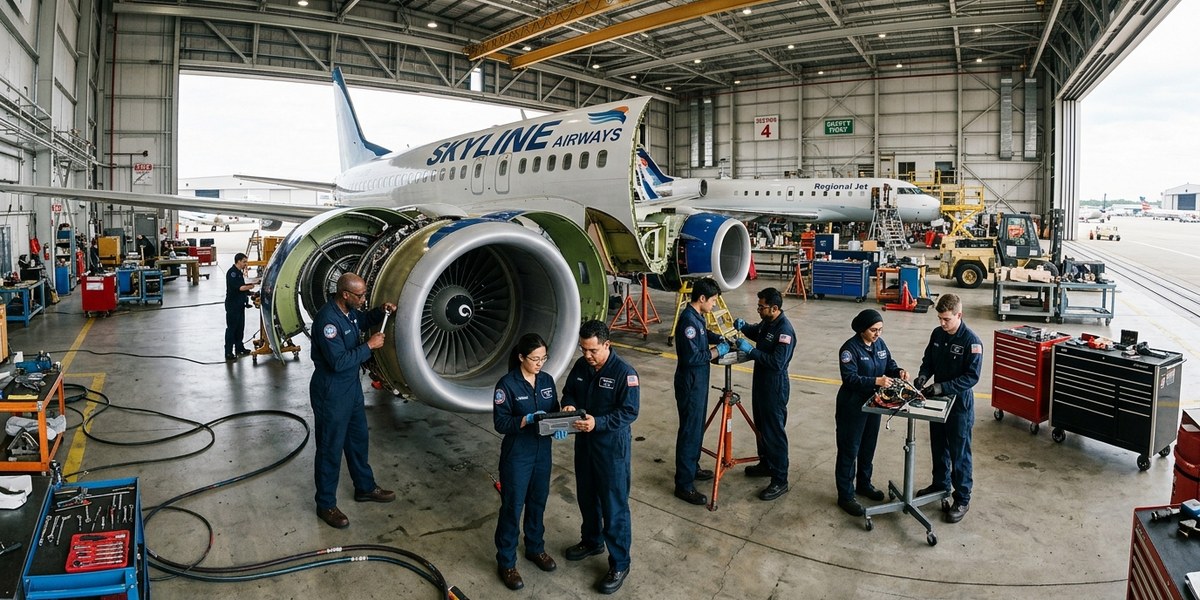
Roadmap at a Glance
| Key Metric | Details |
|---|---|
| Total timeline | 18–24 months (Part 147 school) or 30 months (experience-based) |
| Total cost / financing (est.) | $2,000–$4,000 (school tuition, test fees, DME practical exam) |
| Primary hurdle | Completing 18–30 months of practical experience or an FAA-approved program |
| Compensation snapshot | Entry-level: $40k–$55k; median annual wage ~$70k (2026 BLS data) |
What This Credential Is and Why It Matters
The Airframe and Powerplant (A&P) certificate is the gold-standard credential for aircraft mechanics in the United States, issued by the Federal Aviation Administration (FAA).
It legally authorizes you to inspect, repair, and maintain aircraft airframes and engines, which is a requirement for most a&p mechanic jobs at airlines, repair stations, and corporate flight departments.
Without this certificate, you cannot perform safety-sensitive maintenance on certificated aircraft, making it an essential career milestone.
Employers prioritize A&P-certified mechanics because the credential proves you have met rigorous federal standards for technical knowledge and hands-on skill.
The certificate is also portable across the aviation industry, giving you flexibility to work on everything from small private planes to large commercial jets.
For anyone serious about a long-term career in aviation maintenance, the A&P is non-negotiable.
Eligibility: Who Can Test
Before you can register for any part of the A&P exam, you must meet the FAA’s eligibility requirements. These are designed to ensure you have the foundational knowledge and practical experience to work safely on aircraft.
- Be at least 18 years old
- Be able to read, write, speak, and understand English
- Have 18 months of practical experience with either airframes or powerplants, or 30 months for both (A&P), or complete an FAA-approved Part 147 aviation maintenance technician school
- Pass all required knowledge (written) tests
- Pass all required practical (oral and hands-on) tests
If you choose the experience route, you must document your work hours with a logbook signed by a certified mechanic or supervisor.
For the school route, your Part 147 program will issue a certificate of completion that satisfies the experience requirement. Both paths lead to the same credential, so pick the one that fits your timeline and budget.
Exam Structure and Content
The A&P exam is not a single test but a series of three distinct assessments: a computer-based knowledge test, an oral exam, and a practical hands-on test.
The knowledge test is multiple choice and covers three subject areas: General, Airframe, and Powerplant. You must pass each section separately.
The oral and practical tests are administered together by an FAA Designated Mechanic Examiner (DME) and focus on your ability to explain and perform real maintenance tasks.
General
This domain covers the fundamentals every mechanic needs, regardless of specialization. Study focus includes basic electricity, aircraft drawings, weight and balance calculations, physics principles, materials identification, and FAA regulations.
Expect about 60 questions on the knowledge test for this section.
Airframe Structures
Here you will be tested on the physical construction and repair of aircraft frames. Study focus includes sheet metal fabrication, welding techniques, wood structures, fabric covering methods, and corrosion control.
This domain is heavy on practical knowledge of materials and repair procedures.
Airframe Systems
This domain covers the mechanical and electrical systems that make an aircraft fly. Study focus includes hydraulics, landing gear operation, flight controls, cabin atmosphere systems, and fuel systems.
You need to understand how these systems interact and how to troubleshoot common failures.
Powerplant
The engine is the heart of the aircraft, and this domain ensures you can keep it running. Study focus includes reciprocating and turbine engines, ignition systems, lubrication, fuel metering, and propellers.
Both theory and hands-on knowledge are tested here, especially for engine run-up and troubleshooting.
Preparation Roadmap
Follow this structured plan to prepare for all parts of the A&P exam. Adjust the timeline based on your existing experience and study schedule.
-
Foundation Study: Learn FAA regulations, basic aircraft theory, and safety practices. This phase builds the groundwork for everything else. Typical duration: 2–4 weeks.
-
Knowledge Test Prep: Study FAA test guides and take practice exams for General, Airframe, and Powerplant. Focus on areas where you score lowest. Typical duration: 4–8 weeks.
-
Oral and Practical Practice: Practice hands-on tasks such as rigging, engine run-up, and troubleshooting, and rehearse oral questioning with a mentor or instructor. Typical duration: 2–4 weeks.
-
Final Review and Mock Exams: Simulate the full exam experience, review weak areas, and confirm readiness. Typical duration: 1–2 weeks.
Registration and Scheduling
Once you meet eligibility and have prepared, follow this checklist to register and schedule your exams. Note that the knowledge tests and the oral/practical are scheduled separately.
- Confirm eligibility (experience or school completion)
- Obtain FAA Form 8610-2 (Mechanic Application) signed by a certified instructor or FAA inspector
- Schedule knowledge tests through PSI or a designated testing center
- Pay applicable fees (knowledge test ~$150–$200 per section; DME oral/practical ~$500–$1,000 total)
- Bring valid government-issued photo ID and proof of eligibility to the test site
You can take the three knowledge tests in any order, but most candidates start with General since it is the broadest. Schedule each test at least two weeks apart to allow for review.
For the oral/practical, contact a local DME directly to arrange a date; availability can vary, so book early.
Note: The FAA does not require you to pass all knowledge tests before attempting the oral/practical. However, most DMEs prefer you to have completed all written exams first, as it demonstrates foundational knowledge.
Check with your chosen examiner for their specific policy.
Exam Day: What to Expect
Exam day is the culmination of your preparation, and knowing the logistics helps you stay focused.
For the knowledge test, you will check in at a PSI testing center, present your ID and confirmation number, and then take the computer-based multiple-choice exam in a proctored room. You will receive your score immediately upon completion. For the
oral and practical, you will meet your Designated Mechanic Examiner (DME) at their facility, typically a hangar or repair station, where the examiner will first ask oral questions related to the airframe and powerplant topics you studied, then guide
you through hands-on tasks on actual aircraft components.
Knowledge Test Procedure
Arrive at least 30 minutes early for your scheduled knowledge test. Bring your valid government-issued photo ID and the confirmation email from PSI. You will store personal items in a locker before entering the testing room.
The test is timed—typically two hours for each section—so pace yourself. Read each question carefully, use the process of elimination, and flag questions you want to review before submitting.
After you finish, the computer will display your score, and you will receive a printed score report.
Oral and Practical Exam Procedure
Dress appropriately for a hangar environment—wear closed-toe shoes, avoid loose jewelry, and bring any tools the DME specified in advance.
The oral portion usually lasts 30–60 minutes, with the DME asking questions about regulations, systems, and troubleshooting scenarios. If you don’t know an answer, explain your reasoning or ask for clarification;
examiners often appreciate logical thinking over a perfect guess. The practical portion follows, where you will complete tasks like rigging a flight control, performing an engine run-up, or inspecting a fuel system component.
The DME will observe your technique, safety habits, and ability to follow instructions. Stay calm, work methodically, and don’t rush—accuracy matters more than speed.
If You Need to Retake
Failing a portion of the A&P exam is not the end of the road; many mechanics retake sections before earning their certificate. The FAA’s retake policy is straightforward but has specific rules depending on which part you failed.
For knowledge tests, you must wait 30 days before retaking the same section unless you present a signed statement from an instructor certifying that you have received additional training in the areas you missed.
This waiting period is designed to ensure you take time to study rather than simply retesting immediately.
For the oral and practical, there is no formal waiting period—you can retest with the same DME as soon as you feel ready, or you can schedule a new appointment with a different examiner.
However, you must address the deficiencies the DME noted during your first attempt.
How to Prepare for a Retake
Start by reviewing your score report or the DME’s feedback to identify exactly which topics caused the failure. Focus your study time on those weak areas rather than redoing all your preparation from scratch.
For knowledge test retakes, take at least two additional full-length practice exams targeting the sections you missed. For oral and practical retakes, ask the DME for specific guidance on which tasks to practice more thoroughly.
Many candidates find that working with a mentor or instructor for a few focused sessions makes the difference between failing and passing on the second attempt.
After You Pass: Next Steps
Passing the A&P exam is a major milestone, but your journey as an aircraft mechanic is just beginning. Immediately after you pass the oral and practical, your DME will issue a temporary A&P certificate, which allows you to start working right away.
Your permanent certificate will arrive by mail from the FAA within 6–8 weeks. Keep the temporary certificate in a safe place and carry it with you when working on aircraft.
Once you have the certificate, you can begin applying for A&P mechanic jobs with airlines, repair stations, corporate flight departments, or the military.
Building Your Career After Certification
Consider specializing in a specific aircraft type or system to increase your job opportunities. Many mechanics focus on turbine engines, avionics, or particular airframes like Boeing or Airbus models.
Specialization often leads to higher pay and more job security.
Additionally, maintain your currency by working on aircraft regularly—the FAA requires you to have worked as a mechanic for at least 6 months in the preceding 24 months to exercise your privileges.
If you take a break, you can complete a refresher course to regain currency. There are no continuing education units required for the A&P certificate itself, but staying current with new technologies and regulations is essential for career growth.
Job Market and Salary Outlook
The demand for A&P mechanics remains strong in 2026, driven by airline fleet expansions and retirements of experienced mechanics.
According to the Bureau of Labor Statistics, employment of aircraft mechanics and service technicians is projected to grow about 6% from 2022 to 2032, about as fast as the average for all occupations.
The median annual wage for aircraft mechanics in the United States is around $70,000, with top earners in airline and corporate settings exceeding $90,000.
Entry-level positions typically start between $45,000 and $55,000, but experienced mechanics with specialized skills can earn significantly more.
Salary by Practice Setting
| Practice Setting | Starting Salary (est.) | Work-Life Balance |
|---|---|---|
| Major Airlines | $55,000–$65,000 | Shift work, weekends, and holidays; union protections often improve schedule stability |
| Regional Airlines | $45,000–$55,000 | Similar to major airlines but smaller teams; may offer more overtime |
| Repair Stations | $50,000–$60,000 | Typically daytime hours, but some stations operate multiple shifts |
| Corporate Flight Departments | $60,000–$75,000 | More predictable schedules; often Monday–Friday with occasional on-call duty |
| Military Contractors | $65,000–$80,000 | Variable; may require travel or deployment; competitive benefits |
Official Resources
Accessing the right official resources ensures you have accurate, up-to-date information for your A&P journey. The FAA publishes a wealth of free materials that cover every aspect of the exam and career.
Start with the FAA’s Aviation Maintenance Technician Handbook, available as a free PDF on the FAA website. This handbook is the primary study text for the knowledge tests and covers General, Airframe, and Powerplant topics in depth.
Additionally, the FAA Advisory Circulars provide detailed guidance on regulations, safety practices, and maintenance procedures. For test-specific preparation, the FAA also releases sample questions and test guides that mirror the actual exam format.
- FAA Aviation Maintenance Technician Handbook – Free PDF covering all exam domains
- FAA Advisory Circulars – Official guidance on regulations and best practices
- PSI Testing Centers – Schedule knowledge tests and find locations near you
- FAA Mechanic Certification Page – Detailed eligibility and application information
- O*NET Online – Occupational data for aircraft mechanics, including salary and outlook
External links to these resources are provided below for your convenience. Always verify the current version of FAA materials, as updates are released periodically.
The Bureau of Labor Statistics also publishes annual data on employment and wages for aircraft mechanics, which can help you evaluate job prospects in different regions.
Suggested Reading
- Explore the CareerHowto home page for more career guides and exam preparation resources across technical trades.
- Read our detailed breakdown of the FAA knowledge test format to understand question types and scoring before you schedule your exams.
- Check out tips for negotiating your first A&P mechanic job offer, including how to leverage your new certification for better pay.
- Learn about the differences between working for a major airline versus a repair station to decide which path fits your lifestyle.
- Review the latest FAA regulations on mechanic currency to ensure you maintain your certificate without gaps.
Frequently Asked Questions
How long does it take to get an A&P certificate?
If attending a Part 147 school, the program typically takes 18–24 months. With on-the-job experience, you need 30 months for both ratings.
Can I take the A&P knowledge test online?
No, the knowledge tests are administered in person at FAA-approved testing centers, such as PSI locations.
What is the pass rate for the A&P exam?
Pass rates vary, but first-time pass rates for the knowledge tests are estimated around 70–80%. The oral/practical pass rate is higher, often above 85% for well-prepared candidates.
Do I need to renew my A&P certificate?
No, the A&P certificate does not expire. However, to exercise the privileges of a mechanic, you must have worked on aircraft for at least 6 months in the preceding 24 months or take a refresher course.
