To become an aircraft mechanic, you typically need 18 to 24 months of FAA-approved training, costing an estimated $15,000 to $40,000, followed by passing the Airframe and Powerplant (A&P) exams.
The primary bottleneck is mastering the FAA oral and practical tests. The median salary for aircraft mechanics is $70,010 per year (BLS, 2025), making this a strong investment in a stable trade.
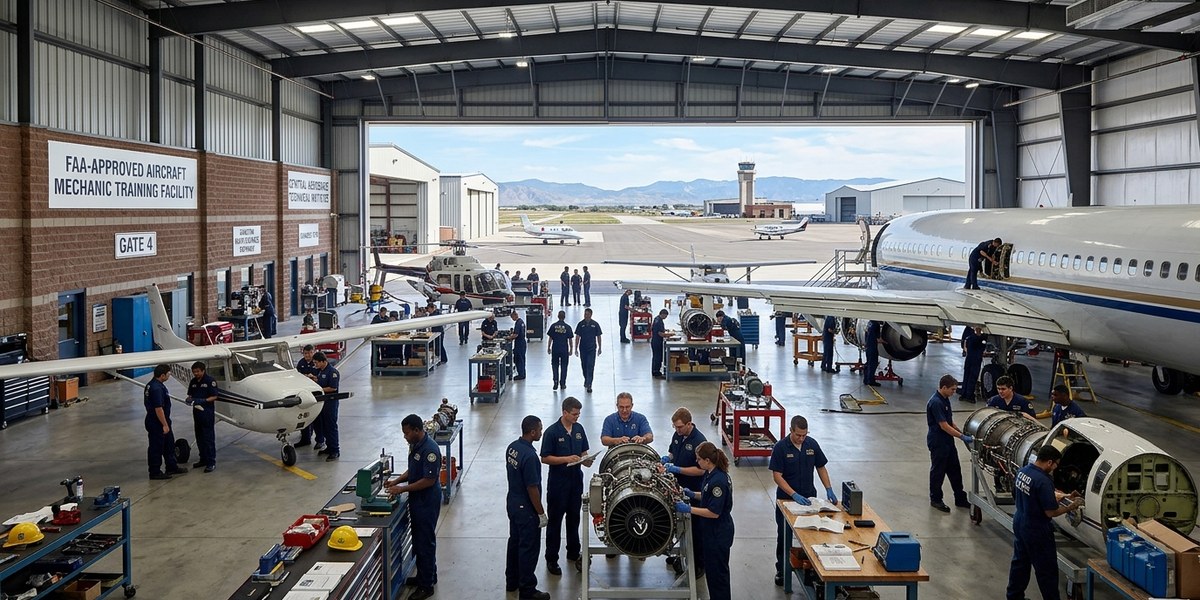
Roadmap at a Glance
| Category | Snapshot |
|---|---|
| Total timeline | 18 months (fastest) to 4–5 years (conservative, part-time) |
| Total cost / financing (est.) | $17,650–$47,150 (tuition, exams, tools, study materials) |
| Primary hurdle | Passing the FAA A&P written, oral, and practical exams |
| Compensation snapshot | $70,010 median annual salary; top earners exceed $90,000 |
Who This Roadmap Is For (and Not For)
This roadmap is for you if you are at least 18 years old, have a high school diploma or GED, and want a hands-on career where you troubleshoot complex mechanical systems.
It is ideal for those who enjoy working with tools, solving problems under pressure, and prefer a structured path to certification over a four-year degree.
This roadmap is not for you if you are looking for a desk job, cannot handle shift work or tight deadlines, or are unwilling to invest significant time in studying FAA regulations.
It also may not suit someone who wants to work only on electronics—consider avionics technician instead.
The Big Picture: Stages From Zero to Job-Ready
The journey to becoming an aircraft mechanic breaks down into five clear phases. First, you research prerequisites and choose between a Part 147 school or on-the-job training.
Second, you complete FAA-approved training, earning a certificate or associate degree. Third, you pass the A&P exams to earn your license. Fourth, you gain entry-level experience, often as a trainee.
Fifth, you pursue additional certifications like Inspection Authorization (IA) to advance.
Each phase has distinct costs, timelines, and decision points. The entire process from start to job-ready typically spans two to three years for full-time students.
Time Investment: Realistic Ranges
The fastest timeline is 18 months if you attend a full-time Part 147 program and schedule your FAA exams immediately after graduation. The typical timeline is two to three years, which accounts for exam prep and job search time.
A conservative timeline of four to five years applies if you train part-time or accumulate 30 months of on-the-job experience instead of attending school.
Most students fall into the typical band. The FAA requires 1,900 hours of training for airframe and powerplant combined, so accelerating beyond 18 months is rare.
Cost Reality Check
| Cost Item | Estimated Amount |
|---|---|
| FAA Part 147 school tuition | $15,000–$40,000 for full program |
| FAA A&P exam fees | $500–$1,500 for written, oral, and practical |
| Tools and equipment | $2,000–$5,000 for basic mechanic toolset |
| Background check and drug screening | $50–$150 per employer requirement |
| Study materials and prep courses | $100–$500 for books and online resources |
Total estimated costs range from $17,650 to $47,150. Tuition is the largest expense, but many schools offer financial aid and payment plans. Tools are a one-time investment that lasts throughout your career.
Phase-by-Phase Action Plan
-
Phase 1: Research and Prerequisites
Confirm you meet basic eligibility: you must be at least 18 years old and hold a high school diploma or GED. Research FAA-approved Part 147 schools in your area or online. Compare program lengths, costs, and placement rates.
When evaluating schools, look beyond the brochure. Visit the campus if possible, talk to current students, and ask about the school’s relationship with local airlines and repair stations.
Some schools have direct hiring pipelines that can place you in a job within weeks of graduation. Others may leave you competing with hundreds of other graduates for the same few openings.
Check the school’s FAA exam pass rate—anything below 70 percent should raise a red flag.
Also consider the school’s location: schools near major airports or aviation hubs like Dallas, Atlanta, or Seattle often have stronger industry connections and more internship opportunities.
If you are considering the on-the-job training route instead of school, understand that this path requires you to find a certified mechanic willing to supervise your training for 30 months.
This is increasingly difficult to arrange, as most repair stations and airlines prefer to hire already-certified mechanics. The school path is almost always faster and more reliable, but it does require a larger upfront financial commitment.
Another important factor to research is the type of aircraft you will train on. Some schools focus primarily on small general aviation aircraft like Cessnas and Pipers, while others have access to larger commercial jets.
If your goal is to work for a major airline, look for schools that provide hands-on experience with turbine engines and transport-category aircraft.
Schools with strong relationships with regional airlines often have internship programs that let you work on CRJ or Embraer jets before you even graduate. This kind of experience can make your resume stand out when you start applying for jobs.
You should also investigate the school’s job placement assistance services. Some schools have dedicated career services offices that help students with resume writing, interview preparation, and job placement.
Others may simply post job listings on a bulletin board. Ask about the percentage of graduates who find aviation maintenance jobs within six months of graduation.
Schools with placement rates above 80 percent are generally doing a good job of preparing their students for the workforce.
Finally, consider the financial aid options available. Many Part 147 schools qualify for federal student aid, including Pell Grants and student loans. Some schools also offer scholarships specifically for aviation maintenance students.
The Aviation Maintenance Technician Association and other industry organizations offer scholarships that can help offset tuition costs.
If you are a veteran, your GI Bill benefits can cover the full cost of tuition at many Part 147 schools, making this an especially attractive option for military personnel transitioning to civilian careers.
-
Phase 2: Complete FAA-Approved Training
Enroll in a Part 147 school and complete required hours in airframe and powerplant subjects. You will earn a certificate or associate degree in aviation maintenance technology.
Decide early whether to pursue both ratings simultaneously or one at a time.
During training, you will cover a wide range of topics including aircraft structures, hydraulic systems, landing gear, electrical systems, piston and turbine engines, propellers, and FAA regulations.
The curriculum is demanding, with a mix of classroom instruction and hands-on lab work.
Expect to spend significant time in the hangar, working on actual aircraft components and learning to use diagnostic tools like borescopes, multimeters, and compression testers.
One of the most important decisions you will make during this phase is whether to pursue both the airframe and powerplant ratings at the same time or to focus on one first.
Getting both ratings in a single program is almost always the better choice, as it makes you eligible for a wider range of jobs and typically takes only a few months longer than a single rating.
Some schools offer accelerated programs that combine both ratings into a single 18-month curriculum, which is the fastest route to certification.
During training, take advantage of every opportunity to work on different aircraft types. The more variety you experience—from small single-engine Cessnas to large commercial jets—the more versatile you will be as a mechanic.
Many schools have partnerships with local repair stations that allow students to work on real aircraft under supervision, which is invaluable experience for the practical exam and for your first job.
Your training will also include significant coursework in FAA regulations and documentation. You will learn how to read and interpret maintenance manuals, service bulletins, and airworthiness directives.
This documentation is a critical part of the job, and mastering it during school will make your transition to the workplace much smoother.
Many students underestimate the amount of paperwork involved in aircraft maintenance, but proper documentation is legally required for every repair and inspection.
Time management is crucial during this phase. Most Part 147 programs require 40 to 50 hours per week of classroom and lab time, similar to a full-time job. You will need to study outside of class as well, especially for the FAA written exams.
Many students find it helpful to form study groups with classmates, quizzing each other on systems and regulations.
Some schools offer evening or weekend programs for students who need to work during the day, but these programs typically take longer to complete.
Another aspect to consider is the physical demands of the training. Aircraft maintenance is a physically active job that requires standing for long periods, working in awkward positions, and occasionally lifting heavy components.
You will be working in hangars that can be hot in summer and cold in winter, and you may be exposed to chemicals like solvents and lubricants. Make sure you are comfortable with these conditions before committing to the program.
-
Phase 3: Pass FAA A&P Exams
Prepare for the written, oral, and practical tests for both ratings. Schedule your exams with an FAA-designated mechanic examiner. Study FAA regulations, aircraft systems, and maintenance procedures thoroughly.
The A&P exam process consists of three parts for each rating: a written test, an oral exam, and a practical test. The written tests are multiple-choice and cover topics like aircraft systems, maintenance practices, and FAA regulations.
You will need to pass two written exams—one for airframe and one for powerplant—each with about 100 questions.
Most students spend several weeks to a few months preparing for the written exams using study guides, online practice tests, and classroom review sessions.
The oral exam is conducted by an FAA-designated mechanic examiner (DME) and typically lasts one to two hours per rating. The examiner will ask you questions about aircraft systems, troubleshooting procedures, and regulatory requirements.
The key to passing the oral exam is not just memorizing facts but understanding how systems work and being able to explain your reasoning clearly.
Many students find the oral exam more challenging than the written tests because it requires real-time thinking and communication skills.
The practical test is the most hands-on portion of the exam.
You will be asked to perform specific maintenance tasks on actual aircraft components, such as inspecting a landing gear assembly, troubleshooting an electrical system, or adjusting a carburetor.
The DME will evaluate your technique, your adherence to safety procedures, and your ability to use technical manuals and specifications.
This is where your hands-on training pays off—students who spent plenty of time in the lab during school typically perform better on the practical test.
One common mistake is waiting too long between completing training and taking the exams. The material is fresh right after graduation, and delaying even a few months can mean having to re-study large portions of the curriculum.
Schedule your exams as soon as you feel prepared, ideally within a few weeks of completing your training.
To prepare effectively, create a structured study plan that covers all the topics on the written exams. Use multiple study resources, including the FAA’s own publications like Advisory Circular 65-9A and the Aviation Maintenance Technician Handbook.
Many students find that online practice tests are particularly helpful for the written exams because they simulate the actual test format and help identify areas where you need more study.
Aim to score consistently above 85 percent on practice tests before scheduling your written exams.
For the oral and practical exams, consider doing a mock exam with a classmate or instructor. This will help you get comfortable with the format and reduce anxiety on test day.
Some schools offer prep courses specifically for the oral and practical exams, which can be worth the investment if you are feeling uncertain.
Also, make sure you are familiar with the specific aircraft components and tools you will be tested on—the DME will expect you to know the proper names and functions of common tools and parts.
On test day, arrive early and bring all required documentation, including your training certificate, photo ID, and any study materials you are allowed to reference.
Stay calm and focused, and remember that the DME is evaluating your competence, not trying to trick you. If you do not know the answer to a question, it is better to admit it and explain how you would find the information than to guess incorrectly.
The DME may give you partial credit for demonstrating good troubleshooting approach even if you do not arrive at the correct answer immediately.
-
Phase 4: Gain Entry-Level Experience
Apply for jobs at regional airlines, repair stations, or general aviation shops. Even without 30 months of experience, a Part 147 certificate qualifies you for trainee roles.
Focus on building a strong safety record and learning from senior mechanics.
Your first job as an aircraft mechanic will likely involve routine maintenance tasks like oil changes, tire replacements, and inspections under the supervision of more experienced mechanics.
This is the time to build good habits: always follow the maintenance manual, double-check your work, and never cut corners on safety procedures.
Senior mechanics will be watching your work, and a reputation for thoroughness and reliability will open doors to more complex assignments and faster advancement.
During your first year on the job, focus on learning the specific aircraft types your employer operates. Each aircraft model has its own quirks and common failure points, and experienced mechanics are a valuable source of this knowledge.
Ask questions, take notes, and volunteer for challenging tasks.
Many repair stations and airlines offer internal training programs that can help you earn endorsements in specific systems or aircraft types, which will make you more valuable to your employer and more marketable to future employers.
Networking is also important during this phase. Join professional organizations like the Professional Aviation Maintenance Association (PAMA) or the Aircraft Mechanics Fraternal Association (AMFA).
Attend industry events and trade shows where you can meet mechanics from other companies and learn about job openings.
Many mechanics find their next job through referrals from colleagues, so building a strong professional network early in your career pays dividends later.
Your first job search should be strategic. Regional airlines are often the best starting point because they have high turnover and are frequently hiring new mechanics.
Companies like SkyWest, Endeavor Air, and Republic Airways have large maintenance bases and offer structured training programs for new hires.
Cargo carriers like FedEx and UPS also hire entry-level mechanics, though competition for these positions can be stiffer.
General aviation repair stations that work on business jets and private aircraft are another good option, especially if you prefer working on a wider variety of aircraft types.
When you apply for jobs, highlight your Part 147 training and any hands-on experience you gained during school. Emphasize your familiarity with FAA regulations and your commitment to safety.
Many employers will ask about your experience with specific aircraft types, so be honest about what you have worked on.
If you do not have experience with a particular aircraft, express your willingness to learn and your ability to follow technical manuals.
Once you land your first job, focus on building a strong reputation. Show up on time, complete your assigned tasks thoroughly, and ask for feedback from your supervisor.
Take advantage of any training opportunities your employer offers, whether it is manufacturer-specific training on Boeing or Airbus aircraft or general courses on new technologies like composite repairs or advanced avionics.
The more skills you acquire, the more valuable you become to your employer and the more options you will have for advancement.
-
Phase 5: Obtain Additional Certifications and Advance
After three years of experience, earn Inspection Authorization (IA) to perform annual inspections. Pursue endorsements in turbine engines or composite materials to increase your value.
<
