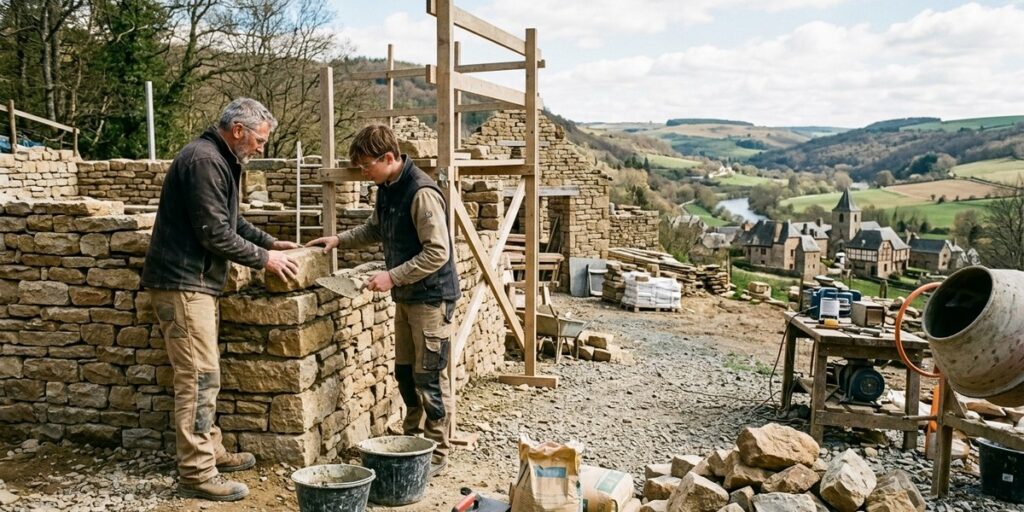
Learning how to become a mason typically takes three to four years through a paid apprenticeship, with total training costs estimated under $5,000 for tools and union dues.
Table of Contents
n
- What Does This Career Do
- Key Terms & 2026 Industry Updates
- Mortar
- NCCER Certification
- Apprenticeship Sponsor
- Lintel
- 2026 Trend: Prefabricated Masonry Panels
- 2026 Trend: Digital Layout Tools
- 2026 Trend: Green Mortar Mixes
- 2026 Trend: Modular Construction Integration
- 2026 Trend: Augmented Reality for Layout
- Is This Career Right for You?
- Requirements
- Licensing & State Variations
- Related Careers
- Related questions
n
n
n
n
n
n
n
n
n
n
n
n
n
n
n
n
n
nn
The primary bottleneck is finding a sponsor employer, but the payoff is a median annual wage of around $48,000 according to the latest available BLS figures, with no student debt required.
This guide covers the exact steps, licensing variations, and insider strategies to enter the trade in 2026.
What Does This Career Do
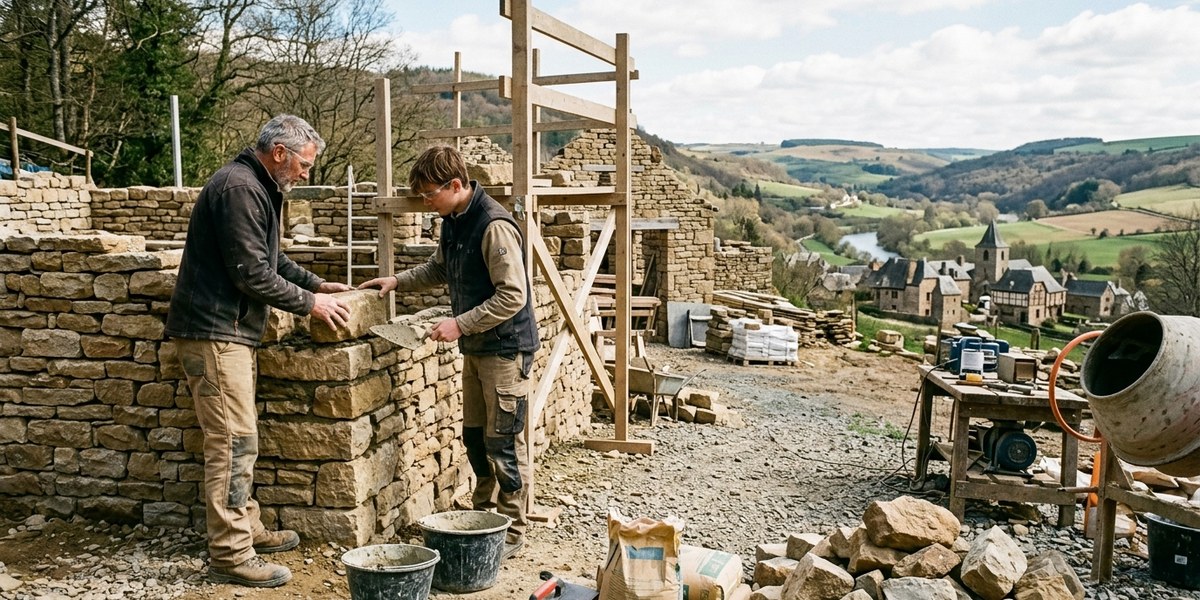
Masons build and repair structures using brick, concrete block, stone, and tile. They work on foundations, walls, patios, and decorative facades for residential and commercial projects.
Unlike general laborers, masons must interpret blueprints and ensure precise alignment and structural integrity. The work requires a combination of physical strength, manual dexterity, and an eye for detail that develops over years of practice.
A mason’s day might involve everything from laying a simple garden wall to constructing a complex arched entryway for a commercial building.
The trade also includes specialized niches such as refractory masons who line industrial furnaces with heat-resistant brick, or restoration masons who repair historic buildings using period-appropriate techniques and materials.
These specializations often command higher wages and require additional training beyond the standard apprenticeship.
- Read and interpret blueprints and construction drawings to determine material needs and layout.
- Mix mortar by hand or machine and apply it with trowels to bond bricks, blocks, or stones.
- Cut materials using powered saws or chisels to fit specific dimensions and patterns.
- Check alignment with levels, plumb lines, and squares throughout the build process.
- Clean excess mortar from finished surfaces and protect work from weather damage.
- Estimate material quantities and costs for projects, accounting for waste and breakage.
- Coordinate with other trades such as carpenters, electricians, and plumbers to ensure proper sequencing of work.
- Maintain and sharpen tools including trowels, chisels, and jointers to ensure clean cuts and efficient work.
- Set up and dismantle scaffolding, ensuring it meets safety standards and provides stable access to elevated work areas.
- Apply sealants and waterproofing treatments to finished masonry to protect against moisture and freeze-thaw damage.
- Inspect existing masonry for cracks, spalling, or other deterioration and recommend repair methods.
- Operate powered equipment such as mortar mixers, brick saws, and forklifts to move materials and prepare work areas.
- Install reinforcing materials like rebar or wire mesh within masonry walls to improve structural strength.
- Build arches, columns, and curved walls using specialized cutting and layout techniques.
Key Terms & 2026 Industry Updates
Understanding the language of masonry helps you communicate on the job site and pass certification exams. Below are essential terms and forward-looking trends for 2026.
Mortar
A workable paste used to bind building blocks together. Different types (Type N, S, M) offer varying strength and flexibility for different applications.
Type N is the most common for general use, Type S is stronger for load-bearing walls, and Type M is used for heavy-duty foundations and retaining walls.
Knowing which mix to use for a given job is a fundamental skill tested in most certification exams. Mortar also varies by color and texture, and matching existing mortar is critical in restoration work.
In 2026, pre-blended mortar mixes are becoming more common on commercial sites, reducing the need for on-site mixing but requiring masons to understand water ratios and working time for each brand.
NCCER Certification
The National Center for Construction Education and Research offers a standardized masonry credential recognized across many states. It is increasingly required by large contractors in 2026.
The certification includes both a written exam and a practical performance test where you must build a mock-up wall to specified dimensions within a time limit.
Holding an NCCER credential can also reduce the number of hours required for state licensure in some jurisdictions. The certification is modular, with Level 1 covering basics and Level 4 covering advanced topics like arches and fireplaces.
Many community colleges now offer NCCER-aligned courses that can be completed in a semester, giving you a head start before applying to apprenticeship programs.
Apprenticeship Sponsor
A licensed contractor or union that hires you as an apprentice, provides on-the-job training, and registers your hours with state or federal authorities.
Sponsors are responsible for ensuring you receive varied experience across different types of masonry work. They also typically cover the cost of your classroom instruction and provide a mentor who supervises your progress on site.
Sponsors are required to follow a structured training plan that outlines the skills you will learn each year. If you feel your sponsor is not providing adequate training, you can file a complaint with your state apprenticeship office.
Some sponsors also offer tuition reimbursement for related coursework, such as blueprint reading or construction management.
Lintel
A horizontal support beam placed over doors and windows to bear the weight of masonry above. Proper lintel installation is a common exam topic.
Lintels can be made of steel, concrete, or stone, and the choice depends on the span length and load requirements.
Incorrect lintel placement is a leading cause of cracking in masonry walls, so understanding bearing capacity and expansion joints is critical.
In seismic zones, lintels must also be anchored to the surrounding structure to prevent movement during earthquakes. Some modern lintels come pre-cast with insulation inserts to improve energy efficiency, a trend that is gaining traction in 2026.
2026 Trend: Prefabricated Masonry Panels
More commercial projects are using factory-assembled wall panels, reducing on-site labor. Masons who learn panel installation and crane signaling will have an edge in the job market.
These panels are built in controlled environments to tighter tolerances, then shipped to the site and lifted into place. This trend is driving demand for masons who can work with precision measurement and coordinate with crane operators.
Panel installation also requires knowledge of lifting points, rigging hardware, and temporary bracing.
Some apprenticeship programs now offer elective modules on panel installation, and the International Masonry Institute has developed a certification specifically for panelized systems.
2026 Trend: Digital Layout Tools
Laser levels, digital angle finders, and layout software are becoming standard on larger job sites. Expect to see these tools in apprenticeship training programs by late 2026.
Digital tools reduce measurement errors and speed up layout work, but they require a basic comfort with technology. Many apprenticeship programs now include a module on using digital levels and total stations for layout.
Some contractors are also adopting building information modeling (BIM) software that allows masons to view 3D models of the structure on tablets.
While you do not need to be a CAD expert, familiarity with reading digital plans and using basic measurement apps will set you apart from candidates who rely solely on traditional methods.
2026 Trend: Green Mortar Mixes
Low-carbon and recycled-content mortars are gaining traction in LEED-certified projects. Knowing how to work with these mixes can differentiate you for higher-paying green jobs.
These mixes often have different setting times and workability compared to traditional mortar, so experience with them is a valuable niche skill.
Some states are also beginning to mandate lower embodied carbon in public construction projects, which will increase demand for masons familiar with these materials.
Green mortars may require different curing conditions, such as misting or covering with wet burlap, to achieve full strength. Understanding these nuances can make you the go-to mason for environmentally conscious contractors.
2026 Trend: Modular Construction Integration
Modular and panelized construction methods are expanding beyond commercial into high-end residential. Masons who understand how to interface modular units with traditional masonry foundations and veneers will find more opportunities.
This trend also increases the need for precise coordination with factory schedules, so communication skills are becoming as important as trowel skills.
Modular construction often requires masons to work with pre-installed anchors and alignment guides, which demands careful attention to tolerances.
Some modular manufacturers offer training programs for masons, and completing one of these can make you a preferred subcontractor for their projects.
2026 Trend: Augmented Reality for Layout
Some large commercial projects are experimenting with augmented reality (AR) headsets that project layout lines directly onto the work surface.
While still niche in 2026, early adopters report significant time savings on complex curved walls and angled corners.
AR tools are expected to become more affordable and common by 2028, so getting comfortable with wearable technology now could pay off later.
A few apprenticeship programs in tech-forward states like California and Washington are already including AR demonstrations in their curriculum.
Is This Career Right for You?
Masonry is a physically demanding trade that rewards precision and patience. It suits people who prefer working outdoors with their hands and want a stable career without a four-year degree. However, it is not for everyone.
The work can be repetitive at times, and the physical toll on knees, back, and shoulders is real. Many experienced masons invest in knee pads, back supports, and proper lifting techniques to extend their careers.
The trade also requires mental stamina, as you must maintain focus on alignment and levelness for hours at a time. Mistakes in masonry are often visible and costly to fix, so attention to detail is non-negotiable.
You may be a good fit if:
- You enjoy physical work and can lift 50-80 pounds repeatedly throughout the day.
- You have strong attention to detail and take pride in creating straight, level structures.
- You can work well in a team and communicate clearly with supervisors and other trades.
- You are comfortable working at heights on scaffolding and have no fear of heights.
- You are self-motivated and can work independently when the task requires focus.
- You are willing to learn continuously, as building codes and materials evolve regularly.
- You enjoy seeing tangible results from your labor at the end of each day.
- You are comfortable with variable weather conditions, including heat, cold, and rain.
This career may not be right if:
- You struggle with kneeling, bending, or standing for long periods.
- You prefer a climate-controlled office environment or variable indoor/outdoor work.
- You are uncomfortable working at heights on scaffolding or in extreme heat or cold.
- You have chronic back, knee, or joint issues that could be aggravated by repetitive lifting and bending.
- You dislike getting dirty or working in dusty, muddy conditions.
- You prefer a predictable routine with minimal travel between job sites.
- You are not comfortable with the seasonal nature of construction work, which can slow down in winter months in colder climates.
How to Become a Mason: Requirements
Before you can start an apprenticeship, you must meet baseline requirements. These are consistent across most states and union programs. Meeting these requirements does not guarantee acceptance, but it ensures you are eligible to apply.
Some programs also require a basic aptitude test covering math and reading comprehension. The aptitude test typically includes questions on fractions, decimals, geometry, and basic algebra, as well as reading passages related to construction safety.
You can find practice tests online or through your local workforce development center.
- Education: High school diploma or GED equivalent.
- Age: Minimum 18 years old (some programs accept 17 with parental consent).
- Physical fitness: Ability to pass a basic physical exam or lift test. This typically involves lifting a 50-pound bag of mortar mix from the ground to waist height repeatedly.
- Driver’s license: Valid state driver’s license and reliable transportation to job sites. Many job sites are not accessible by public transit, especially in suburban or rural areas.
- Math skills: Basic arithmetic and measurement reading (fractions, decimals). You will need to add and subtract fractions regularly when measuring brick courses and mortar joints.
- Certification (optional but recommended): NCCER Masonry Level 1 certification can make your application stand out. Some programs offer a pre-apprenticeship course that includes this certification.
- Continuing education: Some states require ongoing safety training (OSHA 10 or 30) to renew licenses. OSHA 10 is typically sufficient for apprentices, but journey-level masons may need OSHA 30 for supervisory roles.
- Drug screening: Most sponsors require a clean drug test at the time of application and may conduct random tests during the apprenticeship.
- Background check: Some union programs and federal projects require a criminal background check. Certain convictions may disqualify you from working on government-funded sites.
Licensing & State Variations
Licensing for masons varies widely by state and depends on whether you work as an employee or independent contractor.
Most journey-level masons do not need a specific masonry license, but many states require a general contractor license if you work for yourself.
The cost of a contractor license can range from $100 to $1,000 depending on the state, and some require a bond of $10,000 or more. It is important to research your state’s specific requirements before starting your own business.
Additionally, some states have separate classifications for masonry contractors, which may require passing a trade exam that tests your knowledge of materials, structural loads, and building codes.
- States with contractor licensing: California, Florida, Texas, New York, and others require a contractor license for projects over a certain dollar amount (often $500-$5,000). In California, for example, you need a Class C-29 Masonry Contractor license, which requires four years of journey-level experience and passing a trade exam. The exam covers topics like mortar types, reinforcement, and waterproofing.
- States with no statewide masonry license: Many Midwestern and Plains states only require a business license and local permits. However, local municipalities may still have their own requirements, so check with the city or county where you plan to work. For instance, some cities require a separate masonry permit for structural work.
- Union states: In states like Illinois, New Jersey, and Massachusetts, union apprenticeship programs are the primary path and include automatic license eligibility upon completion. Union membership also provides access to health insurance and pension benefits that are harder to obtain as a non-union independent contractor.
- Reciprocity: Some states honor NCCER certification or out-of-state apprenticeship hours, reducing the need for retesting. If you move to a new state, check whether your existing credentials transfer before applying for a new license. The Mason Contractors Association of America maintains a reciprocity database for member states.
- Local variations: Cities such as New York, Chicago, and San Francisco may have additional testing or registration requirements beyond state rules. New York City, for instance, requires a Site Safety Training card for anyone working on certain types of construction sites. Chicago requires a Masonry Contractor license for any work over $3,000.
- Insurance requirements: Many states and clients require general liability insurance and workers’ compensation coverage. Even if not legally required, having insurance protects you from financial loss if an accident occurs on the job. Typical liability coverage for a small masonry contractor is $1 million per occurrence.
- Bonding: Some states require a surety bond to protect clients against incomplete or defective work. Bond amounts range from $5,000 to $25,000 depending on the state and project size.
Tip for 2026: Check your state’s contractor board website before signing any apprenticeship agreement. Some states have recently updated their licensing thresholds, and a few now require liability insurance even for small residential jobs. Also, note that some states are moving toward digital licensing systems, which can speed up the application process but require you to submit documents online. Additionally, several states have introduced reciprocity agreements for NCCER-certified masons, so if you hold that credential, you may
