Becoming a carpenter typically takes 3–4 years through a paid apprenticeship, with total training costs estimated between $1,000 and $5,000 for tools and classroom fees.
The primary bottleneck is securing an apprenticeship sponsor, but the payoff is a median annual wage of $60,240 per the latest BLS figures.
This guide covers the exact steps, licensing variations, and insider strategies to launch your carpentry career.
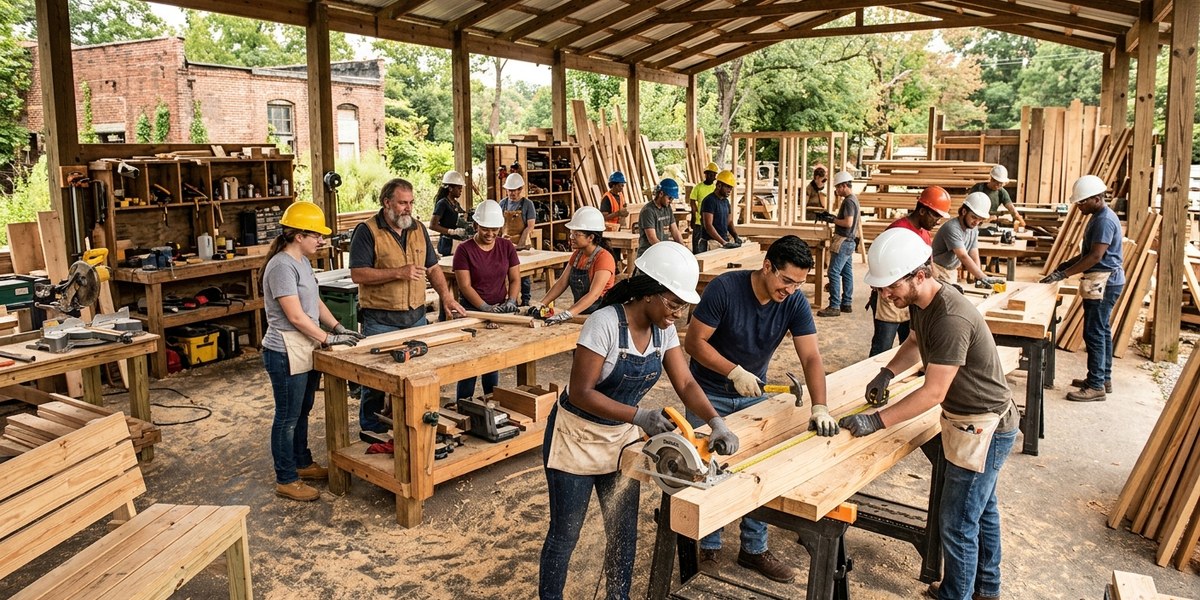
Roadmap at a Glance
| Key Factor | Details |
|---|---|
| Total timeline | 3–4 years (apprenticeship plus classroom instruction) |
| Total cost / financing (est.) | $1,000–$5,000 for tools, safety gear, and class fees; apprentices earn while they learn |
| Primary hurdle | Finding and qualifying for a registered apprenticeship program |
| Compensation snapshot | Median $60,240/year; top earners exceed $90,000 (2026 BLS estimates) |
What Does This Career Do
Carpenters are the backbone of construction, transforming raw materials into the frameworks, finishes, and structures that define buildings. Their work spans residential homes, commercial projects, and industrial sites.
On any given day, a carpenter might frame a new house, install custom cabinetry in a high-rise office, or build concrete forms for a bridge foundation. The role requires a blend of physical skill, mathematical precision, and problem-solving ability.
Unlike many desk-based careers, carpentry offers immediate, tangible results—you can point to a wall you framed or a staircase you built and see the impact of your labor. The work is also deeply collaborative;
carpenters frequently coordinate with electricians, plumbers, and HVAC technicians to ensure that structural elements align with mechanical systems. This means strong communication skills are just as important as technical know-how.
Additionally, carpenters must adapt to varying job site conditions, from muddy residential lots to tight commercial renovations, which demands flexibility and a willingness to learn on the fly.
- Read and interpret blueprints to determine layout, dimensions, and material requirements
- Measure, cut, and assemble lumber, plywood, and other materials for walls, roofs, floors, and decks
- Install doors, windows, cabinets, trim, and molding with precision using power and hand tools
- Build concrete forms, scaffolding, and temporary structures to support other trades
- Inspect and maintain tools and equipment, ensuring compliance with safety standards
- Collaborate with other tradespeople, such as electricians and plumbers, to coordinate project timelines
- Estimate material quantities and costs for bids or project planning
- Perform demolition and site preparation before new construction begins
- Repair or replace damaged wooden structures in existing buildings
- Set up and operate rigging equipment for hoisting materials to elevated work areas
Key Terms & 2026 Industry Updates
Understanding the language of carpentry and where the industry is headed in 2026 will give you an edge. Below are essential terms and forward-looking developments that shape how you train, work, and earn.
Staying informed about these trends can help you choose the right specialty and position yourself for higher wages and job security.
Apprenticeship
A structured program combining paid on-the-job training with related classroom instruction, typically lasting 3–4 years. In 2026, the U.S.
Department of Labor is expanding registered apprenticeship pathways through community colleges and pre-apprenticeship programs, making entry more accessible for candidates without direct construction connections.
Pre-apprenticeship programs, often run by nonprofits or trade schools, can last 8–12 weeks and provide basic safety training and tool familiarity before you commit to a full apprenticeship.
These programs are particularly valuable for career changers or recent high school graduates who lack construction experience. Some pre-apprenticeships even offer stipends or transportation assistance to reduce barriers.
After completing a pre-apprenticeship, participants often receive priority placement into full apprenticeship programs, shortening the overall timeline to journeyman status.
NCCER Certification
The National Center for Construction Education and Research offers a voluntary carpentry credential that validates your skills against industry standards.
By 2026, more employers are requiring NCCER certification as a baseline for hiring, especially on large commercial projects, because it standardizes skill verification across states and companies.
The certification is earned in four levels, each corresponding to roughly one year of apprenticeship training.
Each level includes a written exam and a hands-on performance test that evaluates your ability to complete tasks like framing a wall or installing a door frame.
Holding NCCER certification can also make it easier to transfer between employers or states, as the credential is nationally recognized.
Some community colleges offer NCCER-aligned coursework that counts toward both a degree and apprenticeship hours, giving you a dual benefit.
OSHA 10-Hour Construction Safety
A foundational safety course covering hazard recognition, fall protection, and electrical safety.
Expect OSHA to update its construction standards in 2026 with stricter requirements for silica exposure and ladder safety, making this training even more critical.
Many apprenticeship programs now require the OSHA 10 card before your first day on the job, and some contractors prefer the more comprehensive OSHA 30-Hour course for supervisory roles.
The course is available online or in-person and typically costs between $60 and $100. Completing it early demonstrates to potential sponsors that you take safety seriously, which can set you apart from other applicants.
Additionally, some states mandate OSHA training for all construction workers on public projects, so having the card can open doors to government-funded work.
Green Building and Net-Zero Construction
Carpenters in 2026 will increasingly work with sustainable materials like engineered wood products (e.g., cross-laminated timber) and install framing for solar-ready roofs and energy-efficient envelopes.
The push for net-zero homes means carpenters who understand air-sealing and advanced insulation techniques will be in higher demand.
Green building certifications like LEED and ENERGY STAR are becoming common requirements on new construction projects, and carpenters with knowledge of these standards can command higher wages.
For example, a carpenter who can properly install a continuous air barrier or frame for solar panel mounting may earn $5–$10 more per hour than a general framer. Training in green building is available through organizations like the U.S.
Green Building Council and some community college programs. As more states adopt stricter energy codes, this expertise will become increasingly valuable, potentially leading to specialized roles in energy retrofitting and sustainable design.
Modular and Prefabricated Construction
By 2026, off-site fabrication of wall panels and roof trusses is growing, reducing on-site labor hours. Carpenters who can read digital fabrication drawings and work with pre-assembled components will have a competitive edge in the evolving market.
This shift also means less time spent on repetitive cutting and more focus on precision assembly and installation, which can reduce physical strain and increase efficiency.
Modular construction is particularly popular in multi-family housing and commercial projects where speed and consistency are critical.
Carpenters in this niche often work in climate-controlled factories, which can be appealing for those who prefer a more predictable environment than outdoor job sites.
Learning to use computer-aided design (CAD) software or building information modeling (BIM) tools can further enhance your qualifications for these roles.
- Rough Carpentry
- Structural framing, sheathing, and subflooring—the skeleton of a building. This is where most apprentices start, learning to work with speed and accuracy under supervision. Rough carpentry requires a strong understanding of load-bearing principles and the ability to work in all weather conditions.
- Finish Carpentry
- Trim, molding, cabinets, and staircases—the visible, detail-oriented work that requires precision and an eye for aesthetics. Finish carpenters often work on high-end homes and commercial interiors, and they typically earn higher wages than rough carpenters due to the skill level required.
- Formwork
- Temporary molds built to hold concrete until it sets. Carpenters construct and strip these forms on foundations, walls, and columns. Formwork requires careful measuring and bracing to ensure concrete cures in the correct shape, and it is a critical skill for large infrastructure projects like bridges and dams.
- Scaffolding
- Temporary structures that provide safe access to elevated work areas. Carpenters often build and dismantle scaffolding on job sites, following strict safety guidelines. Proper scaffolding erection is essential for preventing falls, which are a leading cause of injury in construction.
- Millwork
- Custom woodwork produced in a shop, such as cabinets, doors, and paneling. Carpenters who specialize in millwork installation must be adept at precise measurements and finishing techniques.
Is This Career Right for You?
Carpentry offers a tangible, hands-on career with solid earning potential, but it demands physical resilience and a commitment to precision. Before you invest in training, consider whether your traits align with the daily realities of the job.
The work is rarely monotonous—each project presents new challenges, from uneven terrain to tight deadlines—but it also requires patience and the ability to adapt.
Carpenters often work in teams, so being able to take direction and collaborate is crucial. You will also need to manage your time effectively, as project schedules are often tight and delays can have ripple effects on other trades.
The job can be physically demanding, with long hours of standing, kneeling, and lifting, but many carpenters find the active lifestyle a welcome alternative to sitting at a desk.
Additionally, the sense of accomplishment from completing a structure that will stand for decades is a powerful motivator for those in the trade.
This career suits people who enjoy working with their hands, solving spatial problems, and seeing a finished product at the end of each day. If you prefer a desk job or work that rarely changes location, carpentry may feel grueling.
However, for those who thrive on variety and tangible results, it can be deeply satisfying. It is also a career that offers clear progression—from apprentice to journeyman to master carpenter or contractor—with increasing responsibility and pay.
Many carpenters eventually start their own businesses, giving them control over their schedules and earnings.
If you are someone who values independence and is willing to invest in continuous learning, carpentry can provide a stable and rewarding long-term path.
- Good fit if: You have strong manual dexterity, can lift 50–100 pounds regularly, and thrive in outdoor or partially finished environments. You are comfortable with math (fractions, geometry) and don’t mind getting dirty. You enjoy problem-solving on the fly and can stay focused in noisy, fast-paced settings. You are also willing to learn new techniques and adapt to changing building codes and materials.
- Not a fit if: You dislike working in extreme heat or cold, struggle with heights, or prefer predictable routines. Carpentry involves variable schedules, weather delays, and occasional rush deadlines. If you have chronic back or knee issues, the physical demands may be challenging without accommodations. Additionally, if you are uncomfortable with the inherent risks of construction—such as working with power tools or on scaffolding—this may not be the right career for you.
Requirements
To become a carpenter, you must meet baseline educational criteria and complete specialized training. Below are the core requirements, though state and employer specifics may vary.
Meeting these requirements opens the door to apprenticeship programs and entry-level positions. It is important to note that while some requirements are universal, others depend on the type of carpentry you pursue.
For example, finish carpenters may need additional training in cabinet installation, while rough carpenters focus more on structural framing. Planning your path early can help you tailor your education and experience accordingly.
- Education: High school diploma or equivalent (GED). Courses in algebra, geometry, and shop class are beneficial. Some programs also accept applicants with vocational school credits in construction trades. Taking advanced math classes can help with blueprint reading and material estimation.
- Apprenticeship: Completion of a registered 3- to 4-year apprenticeship program (typically 144 hours of classroom instruction per year plus 2,000 hours of paid on-the-job training). This is the most common and reliable path to journeyman status. Apprenticeships are offered through unions, contractor associations, and community colleges.
- Safety certification: OSHA 10-Hour Construction Safety card is required by most employers and job sites. Some contractors also require OSHA 30 for lead roles. This certification must be renewed every five years in some cases, so check your state’s requirements.
- Optional credentials: NCCER Carpentry Level 1–4 certification can boost hiring prospects and wage potential, especially on commercial and government projects. Each level takes about a year to complete and includes both written and practical exams.
- Physical requirements: Ability to stand, kneel, and climb for long periods; lift heavy materials; and work at heights on scaffolding or ladders. A pre-apprenticeship physical exam is often required to ensure you can handle the demands of the job.
- Driver’s license: Many carpenters need a valid driver’s license to travel between job sites, especially in rural or suburban areas where public transit is limited. A clean driving record can also be a plus for employers who provide company vehicles.
- Background check: Some employers, particularly those working on schools or government buildings, may require a clean criminal record. Felony convictions can disqualify you from certain projects, so it is important to be upfront about your history during the application process.
- Tool ownership: Most carpenters are expected to own a basic set of hand tools, including hammers, tape measures, levels, and chisels. Power tools are often provided by employers, but having your own can make you more versatile and efficient.
Licensing & State Variations
Carpentry licensing is not uniform across the United States. While some states require a general contractor license for carpenters who bid on projects, others have no statewide mandate.
Local municipalities often add their own rules, so it’s essential to research your specific area. The table below summarizes key differences across major states.
Understanding these variations is crucial if you plan to work independently or move to a different state.
Even if you work as an employee, some states require proof of apprenticeship completion for certain job classifications, which can affect your pay rate and job opportunities.
| State | License Required? | Key Details |
|---|---|---|
| California | Yes, for projects over $500 | Must pass trade and business law exams; requires 4 years of journey-level experience |
| Florida | Yes, for projects over $2,500 | Certified or registered contractor license; financial responsibility requirements |
| Texas | No state license, but local permits may apply | Some cities like Houston require business permits; no statewide exam |
| New York | No state license, but NYC requires a license for home improvement contractors | NYC license requires background check and $500 bond |
| Indiana | No state license | No statewide requirements; check local city or county rules |
| Oregon | Yes, for residential projects over $1,000 | Requires continuing education every 2 years; license through CCB |
| Illinois | No state license, but Chicago requires a city license for certain projects | Chicago license requires proof of insurance and a bond |
| Washington | Yes, for projects over $1,000 | Requires registration with the Department of Labor and Industries; bond and insurance required |
- State contractor licenses: States like California, Florida, and Texas require carpenters who work independently on projects over a certain value (e.g., $500 in California) to hold a contractor license, which involves passing a trade exam and a business law exam. These exams test knowledge of building codes, safety regulations, and contract management. The application fees can range from $100 to $500, and you may need to provide proof of insurance and bonding.
- No state license needed: In states such as Indiana and Missouri, there is no statewide carpenter or contractor license, though cities may require a local business permit. This can make it easier to start working independently, but you still need proof of training for most jobs. However, working without a license in these states means you are personally liable for any mistakes or accidents, so carrying insurance is still advisable.
- Union vs. non-union: Union
