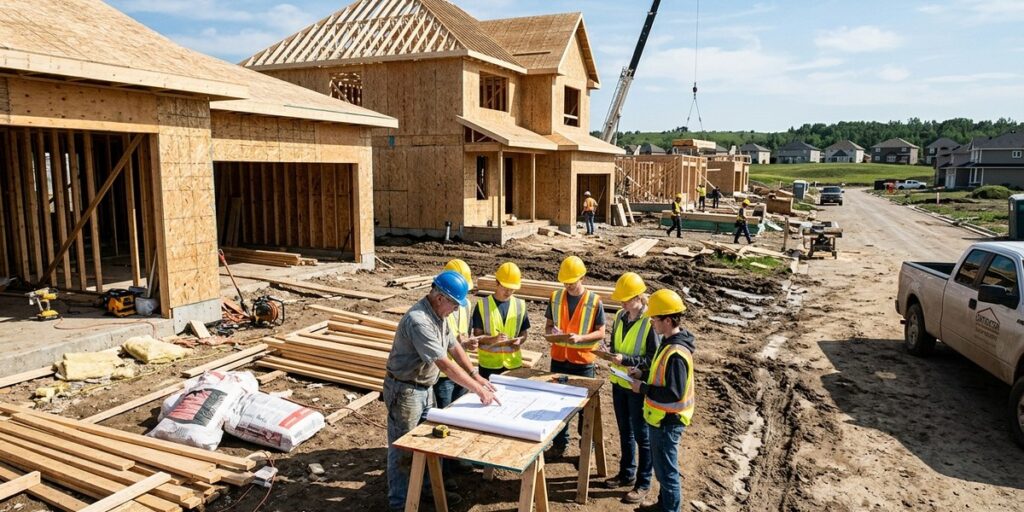
Becoming a home builder typically takes 3-5 years through apprenticeship and on-the-job training, with total education and licensing costs estimated at $5,000-$15,000 before bonding and insurance.
Table of Contents
n
- What Does This Career Do
- Key Terms & 2026 Industry Updates
- Key Terms
- 2026 Industry Updates
- Is This Career Right for You?
- Requirements
- Licensing & State Variations
- Related Careers
- Related questions
n
n
n
n
n
n
n
n
n
n
nn
The primary bottleneck is securing a state contractor’s license, which requires documented experience and passing a trade exam.
Median compensation for experienced home builders falls between $55,000 and $75,000 per year (latest available national estimates). This guide covers the exact steps, licensing, and timeline you need to launch your residential construction career.
What Does This Career Do
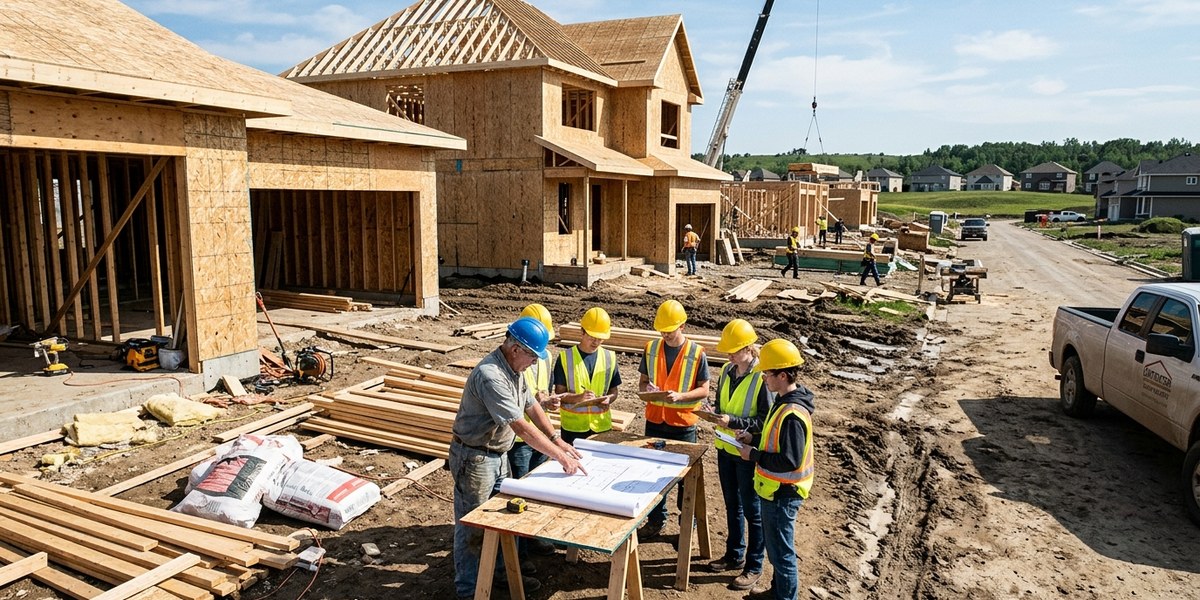
A home builder oversees the entire construction of single-family homes, townhouses, and small multi-unit dwellings-from land preparation to final walk-through.
Unlike a general contractor who may manage commercial or industrial projects, a home builder focuses exclusively on residential work. Typical responsibilities include:
- Reading blueprints and creating material takeoffs to estimate costs and order supplies
- Supervising on-site crews (carpenters, masons, electricians, plumbers) to ensure quality and code compliance
- Scheduling subcontractors and inspections to keep projects on time and within budget
- Conducting site inspections to verify foundation, framing, roofing, and finish work meet specifications
- Managing client communications, change orders, and final punch lists before closing
Beyond these core duties, a home builder must also navigate zoning laws, secure building permits, and coordinate with utility companies for connections.
In many cases, the builder acts as the primary point of contact between the homeowner, the architect, and local government inspectors.
This requires a deep understanding of construction sequencing-knowing when the foundation must be poured before framing can begin, and when rough-in inspections for plumbing and electrical must happen before insulation and drywall.
A typical single-family home project involves 20 to 30 distinct subcontractors, each with their own schedule and deliverables. The home builder must orchestrate these trades to avoid costly delays and rework.
For example, if the drywall crew arrives before the electrical rough-in is inspected, the builder may have to pay for a second trip, eating into profit margins.
Experienced builders develop a sixth sense for anticipating these bottlenecks and building buffer time into the schedule.
They also maintain relationships with suppliers to secure favorable pricing on lumber, windows, roofing materials, and fixtures-often negotiating bulk discounts that can save 10-15% on material costs across a year of projects.
Another critical aspect of the home builder’s role is financial management. You are responsible for creating accurate project budgets that account for materials, labor, permits, and contingencies.
A typical budget for a 2,000-square-foot home might allocate 40% to materials, 30% to labor, 15% to subcontractors, 10% to permits and fees, and 5% to contingency. If you underestimate any category, your profit margin evaporates.
Builders also manage cash flow carefully, because they often pay subcontractors weekly or biweekly while waiting for progress payments from clients or lenders.
A common mistake among new builders is taking on too many projects at once, stretching their cash reserves thin. Seasoned builders recommend having at least three months of operating expenses in reserve before starting your first solo project.
They also advise using a construction loan or line of credit to bridge gaps between payments.
Understanding lien laws is equally important-if you fail to pay a subcontractor, they can place a mechanic’s lien on the property, which can halt the sale and damage your reputation.
Many builders use lien waivers to protect themselves, requiring subcontractors to sign a waiver before receiving final payment.
The home builder also plays a key role in quality control. You are the last line of defense before a home is handed over to the buyer. This means inspecting every phase of construction, from the foundation pour to the final paint touch-up.
Builders develop checklists for each phase: for example, during the framing inspection, you check that studs are spaced 16 inches on center, headers are properly sized over windows and doors, and shear walls are installed correctly.
During the finish phase, you verify that cabinets are level, countertops are sealed, and plumbing fixtures are leak-free. Many builders conduct a pre-drywall walkthrough with the homeowner to catch any issues before walls are closed up.
This builds trust and reduces the likelihood of costly change orders later. Some builders also offer a one-year warranty on workmanship, covering issues like nail pops, drywall cracks, and settling.
Handling warranty claims promptly and professionally is essential for maintaining a good reputation and generating referrals.
Key Terms & 2026 Industry Updates
The home building industry evolves with new materials, energy codes, and technology. Below are essential terms and forward-looking trends shaping the field in 2026.
Key Terms
- Blueprint
- A detailed architectural drawing that shows floor plans, elevations, and structural details for a residential project.
- Takeoff
- The process of measuring and counting materials from blueprints to create a cost estimate and order list.
- Subcontractor
- A specialized trade contractor (e.g., electrician, plumber, roofer) hired by the home builder to perform specific work.
- Punch list
- A final checklist of minor repairs, touch-ups, or incomplete items that must be finished before the homeowner accepts the property.
- Building code
- A set of local or state regulations governing construction safety, structural integrity, and energy efficiency.
2026 Industry Updates
- Net-zero ready homes: By 2026, more states are adopting the 2024 International Energy Conservation Code, requiring home builders to incorporate solar-ready roofs, high-efficiency HVAC, and advanced insulation.
- Modular and panelized construction: Off-site prefabrication is growing, reducing on-site labor needs by 20-30% and shortening build times-home builders who partner with modular suppliers gain a competitive edge.
- Digital project management: Cloud-based platforms (e.g., BuilderTrend, Procore) are becoming standard for scheduling, document sharing, and client updates, making tech-savvy home builders more efficient.
- Labor shortage pressure: The construction industry continues to face a skilled labor gap in 2026, pushing home builders to invest in training programs and offer competitive wages to retain crews.
- Resilience upgrades: Wildfire- and flood-resistant materials (e.g., ignition-resistant siding, elevated foundations) are increasingly required in high-risk zones, adding both cost and specialization opportunities.
In addition to these trends, home builders in 2026 are also grappling with rising material costs. Lumber prices, which spiked during the pandemic, have stabilized but remain about 30% higher than pre-2020 averages.
Concrete and steel have seen similar increases due to supply chain disruptions and global demand.
Builders are responding by locking in prices with suppliers earlier in the design phase and using alternative materials like engineered wood products or insulated concrete forms (ICFs) that offer better thermal performance and cost predictability.
Another emerging trend is the use of drone technology for site surveys and progress monitoring.
Drones can capture aerial images and create 3D models of a construction site in minutes, allowing builders to track excavation progress, verify foundation alignment, and document work for client updates.
This technology is especially valuable for large subdivisions where multiple homes are under construction simultaneously. Finally, the push for sustainable building practices is no longer optional in many markets.
Home buyers increasingly expect Energy Star-rated appliances, low-VOC paints, and recycled-content materials.
Builders who can market their homes as “green” often command a premium of 5-10% over comparable conventional homes, making sustainability a profitable differentiator.
Another significant update in 2026 is the growing adoption of building information modeling (BIM) in residential construction.
While BIM has been common in commercial projects for years, affordable software options are now available for home builders.
BIM allows you to create a 3D digital model of the home that includes structural, mechanical, electrical, and plumbing systems. This helps identify clashes-like a duct running through a beam-before construction begins, saving time and money.
Some builders use BIM to generate accurate material quantities, reducing waste by up to 15%. Additionally, the rise of smart home technology is changing how builders wire and plumb homes.
Many buyers now expect pre-wiring for security cameras, smart thermostats, and voice-controlled lighting. Builders who stay current with these technologies can offer homes that appeal to tech-savvy buyers, often at a premium.
Finally, the insurance landscape is shifting in 2026. Some carriers are raising premiums for builders in wildfire- or flood-prone areas, while others offer discounts for using fire-resistant materials or installing sprinkler systems.
Shopping around for insurance and bundling policies can save thousands of dollars annually.
Is This Career Right for You?
Home building demands a mix of hands-on construction knowledge, business acumen, and people skills. You’ll work outdoors in all weather, manage tight deadlines, and solve problems on the fly.
If you enjoy seeing tangible results and leading a team, this career can be deeply rewarding.
Before committing, consider whether your natural strengths align with the role’s demands. The lists below can help you gauge fit.
- Good fit if: You are comfortable supervising crews, reading blueprints, and handling budgets; you enjoy varied tasks and don’t mind physical work; you have strong communication skills for client and subcontractor coordination.
- Not a fit if: You prefer a predictable 9-to-5 desk job; you dislike managing multiple moving parts under pressure; you are not willing to invest in licensing and continuing education.
CareerHowto Insight: Many successful home builders start as carpenters or laborers to build field experience before pursuing a license.
Even if you plan to earn a degree, working a summer on a framing crew will give you invaluable practical knowledge.
To further assess your fit, consider taking a construction aptitude test or volunteering with a local Habitat for Humanity chapter. These experiences expose you to the physical demands and teamwork required on a job site.
You might also shadow a licensed home builder for a week to see the daily reality-early mornings, constant phone calls, and the satisfaction of watching a foundation turn into a finished home.
Many builders report that the most challenging aspect is not the construction itself but the business side: estimating accurately, managing cash flow, and dealing with clients who change their minds mid-project.
If you thrive on variety and problem-solving, these challenges become opportunities. But if you crave routine and predictability, a role as a project estimator or building inspector might be a better fit.
The key is to be honest with yourself about your tolerance for risk and your willingness to learn continuously. The best home builders are lifelong students of their craft, always seeking new techniques, materials, and management strategies.
Another way to test your fit is to assess your personality traits against the demands of the job. Home builders need to be detail-oriented but also able to see the big picture.
You might spend an hour reviewing a subcontractor’s invoice for accuracy, then pivot to discussing the overall project timeline with a client. This requires mental flexibility and the ability to switch contexts quickly.
Builders also need resilience-projects will go wrong. A supplier might deliver the wrong windows, a rainstorm could delay the foundation pour by a week, or a client might demand a change that requires reordering materials.
How you handle these setbacks defines your success. Builders who stay calm, communicate clearly, and find solutions quickly earn the trust of their clients and crews.
If you are prone to stress or frustration when plans change, this career may be challenging. Finally, consider your financial situation. Starting a home building business requires capital for tools, vehicles, insurance, and marketing.
Many new builders work for an established company for several years to build savings and experience before going out on their own.
If you are debt-averse or need a steady paycheck, working as a project manager for a large home builder might be a better starting point than launching your own firm.
How to Become a Home Builder: Requirements
To become a home builder, you must meet educational, experiential, and licensing requirements that vary by state. Below are the core requirements.
- Education: High school diploma or equivalent (minimum); vocational training in carpentry, building construction technology, or an associate degree in construction management is preferred by many employers.
- Apprenticeship or on-the-job training: 2-4 years of supervised experience in residential construction, often through a union apprenticeship or working as a carpenter or laborer for a licensed builder.
- OSHA 30-Hour Construction Safety: Required by most general contractors and many state licensing boards to ensure worksite safety knowledge.
- State contractor license: Most states require passing a trade and business law exam (e.g., NASCLA exam) and providing proof of experience, financial solvency, and liability insurance.
- Continuing education: Many states mandate periodic CE credits to renew your license, covering code updates, safety, and business practices.
Beyond these formal requirements, successful home builders often possess a set of soft skills that are harder to quantify but equally important.
Financial literacy is critical-you need to understand profit and loss statements, cash flow projections, and tax implications of business expenses. Many builders take basic accounting courses or use software like QuickBooks to track job costs.
Communication skills are another must: you will negotiate with subcontractors, explain technical issues to homeowners, and present progress reports to lenders or investors.
A builder who cannot clearly articulate a delay or a cost overrun risks losing trust and future business. Finally, physical stamina matters.
While you may not be swinging a hammer every day as a licensed builder, you will be on your feet walking job sites, climbing ladders, and inspecting crawl spaces. Being in reasonable physical condition helps you stay alert and avoid accidents.
Some builders also pursue certifications in first aid and CPR, which can be a lifesaver on remote job sites where emergency services are minutes away.
In addition to these requirements, many states now require home builders to carry workers’ compensation insurance if they have employees.
Even if you are a sole proprietor, some clients and lenders will require proof of coverage before awarding a contract.
The cost of workers’ comp varies by state and trade, but expect to pay 2-5% of your payroll for low-risk office work and 10-20% for high-risk trades like roofing.
You should also consider forming a legal business entity, such as an LLC or corporation, to protect your personal assets from liability.
An LLC is the most common choice for small home builders because it offers liability protection without the complexity of a corporation.
You will need to register your business with your state, obtain an Employer Identification Number (EIN) from the IRS, and open a separate business bank account.
Mixing personal and business finances is a common mistake that can lead to tax problems and liability issues. Finally, some states require home builders to pass a credit check or demonstrate financial solvency as part of the licensing process.
If you have a low credit score, you may need to work on improving it before applying for a license. Paying down debt, disputing errors on your credit report, and building a savings cushion can all help.
Licensing & State Variations
Licensing is the most critical regulatory hurdle for home builders. While requirements differ, nearly every state demands a contractor’s license for projects exceeding a certain dollar threshold (often $500-$5,000).
- Exam requirements: Over 30 states use the NASCLA (National Association of State Contractors Licensing Agencies) exam, which tests trade knowledge and business management. Some states administer their own exams.
- Experience documentation: You must typically provide 2-4 years of verifiable work history under a licensed contractor, including project references and proof of hours.
- Bond and insurance: Most states require a surety bond (e.g., $10,000-$25,000) and general liability insurance ($500,000-$1,000,000 coverage) before issuing a license.
